
Georgia
Georgia has been making wine for around 8,000 years, longer than anywhere else on Earth, and it still does it in buried clay pots.
- CapitalTbilisiNamed after its hot sulphur springs
- PopulationAbout 3.7 millionBetween the Black Sea and the Caucasus
- Area69,700 km2Dominated by the Caucasus Mountains
- WinemakingAbout 8,000 yearsThe oldest tradition in the world
Georgia sits at the meeting point of Europe and Asia, wedged between the Greater Caucasus Mountains in the north and the Lesser Caucasus in the south, with the Black Sea to the west. The mountains are serious: several peaks pass 5,000 m.
Georgian wine is made in qvevri, huge clay vessels buried up to their necks in the ground. Grapes, skins and stems go in, the pot is sealed, and the wine ferments underground. The method is around 8,000 years old and is on the UNESCO heritage list.
National symbols
- National animal Caucasian leopard
- National flower Georgian rose
- National anthem Tavisupleba (Translation: Freedom)
- National day Independence Day, 26 May
Map of Georgia
Geography
Georgia covers 69,700 km2 and borders Russia, Azerbaijan, Armenia and Turkey, with the Black Sea to the west.
The Greater Caucasus form the northern border and include Shkhara at 5,193 m, the country's highest point. The Lesser Caucasus lie in the south. Between them, the Kura and Rioni river valleys hold most of the population and the vineyards.
Climate
Western Georgia, near the Black Sea, is humid subtropical with heavy rainfall, warm winters and enough humidity to grow tea and citrus.
Eastern Georgia is drier and more continental, with hotter summers and colder winters. The high Caucasus are alpine, with glaciers and permanent snow, and the mountains shelter the lowlands from cold northern air.
Culture
Georgian is the official language, written in its own unique alphabet. It belongs to the Kartvelian family, unrelated to Indo-European, Turkic or Semitic languages.
The supra, a long feast led by a toastmaster called the tamada, is a central Georgian tradition with formal rounds of toasts. Georgian polyphonic singing, in three independent vocal parts, is on the UNESCO heritage list. Around 84 per cent of Georgians are Orthodox Christian.
Economy
Agriculture and food remain important: wine, hazelnuts, tea and citrus. Georgia is one of the world's leading hazelnut exporters.
Tourism has grown rapidly, drawn by the mountains, Tbilisi and the wine regions. Georgia also serves as a transit route for oil and gas pipelines running from the Caspian Sea to Turkey and Europe.
The flag
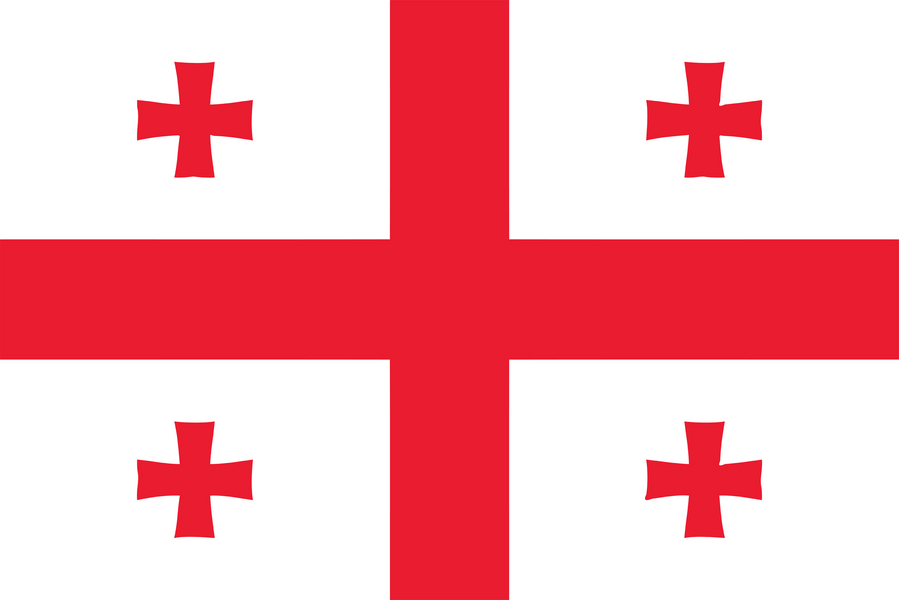
A white field with a large central red cross reaching all four edges, and a smaller red cross in each of the four resulting corners. It is called the Five Cross Flag.
The design is medieval, associated with the Kingdom of Georgia around the 1300s. It was revived by an opposition movement in the 1990s and became the national flag in 2004. The four small crosses are usually said to represent the four evangelists.