
France
France is the most visited country in the world, and its territory reaches from the Alps to islands in the Caribbean, the Indian Ocean and the Pacific.
- CapitalParisVisited by tens of millions every year
- PopulationAbout 68 millionSecond most populous country in the EU
- Area551,695 km2Mainland France, the largest in the EU
- Highest pointMont Blanc, 4,806 mThe highest mountain in western Europe
Mainland France is often described as a hexagon, because its outline has roughly six sides. Inside it are Atlantic beaches, the Mediterranean coast, the Alps, the Pyrenees, the volcanic hills of the Massif Central and a great deal of farmland.
France also governs territories scattered across the globe, including Guadeloupe and Martinique in the Caribbean, Reunion in the Indian Ocean and French Polynesia in the Pacific. Because of them, France has a time zone in almost every part of the world.
National symbols
- National symbol Marianne, a woman in a liberty cap representing the republic
- National animal Gallic rooster
- National anthem La Marseillaise
- National day Bastille Day, 14 July
Map of France
Geography
Mainland France covers 551,695 km2 and borders Belgium, Luxembourg, Germany, Switzerland, Italy, Monaco, Spain and Andorra, with the Atlantic Ocean, English Channel and Mediterranean Sea around it.
The Alps on the Italian border include Mont Blanc at 4,806 m, the highest peak in western Europe. The Pyrenees separate France from Spain. The Loire is the longest river, and the north and west are largely flat, fertile plains.
Climate
France has three main climates. The west is mild and rainy under Atlantic influence, the east and centre have hotter summers and colder winters, and the south has a Mediterranean climate with hot dry summers and mild wet winters.
The Alps and Pyrenees are cold with heavy snow, which is why French ski resorts are among the largest in the world. A strong cold wind called the mistral blows down the Rhone valley to the Mediterranean.
Culture
French is the official language and is spoken by around 300 million people worldwide, largely because of the former French empire in Africa and elsewhere.
France takes food seriously enough that the French gastronomic meal is on the UNESCO cultural heritage list. It produces around 1,600 kinds of cheese. Around 47 per cent of people are Christian and around 40 per cent report no religion.
Economy
France has a large, diverse economy. Aerospace is a flagship: Airbus aircraft are assembled at Toulouse. Nuclear power supplies around 65 to 70 per cent of French electricity, a higher share than any other country.
Luxury goods, wine, cheese and wheat are major exports, and tourism brings in enormous sums. France attracts more international visitors than any other nation.
The flag
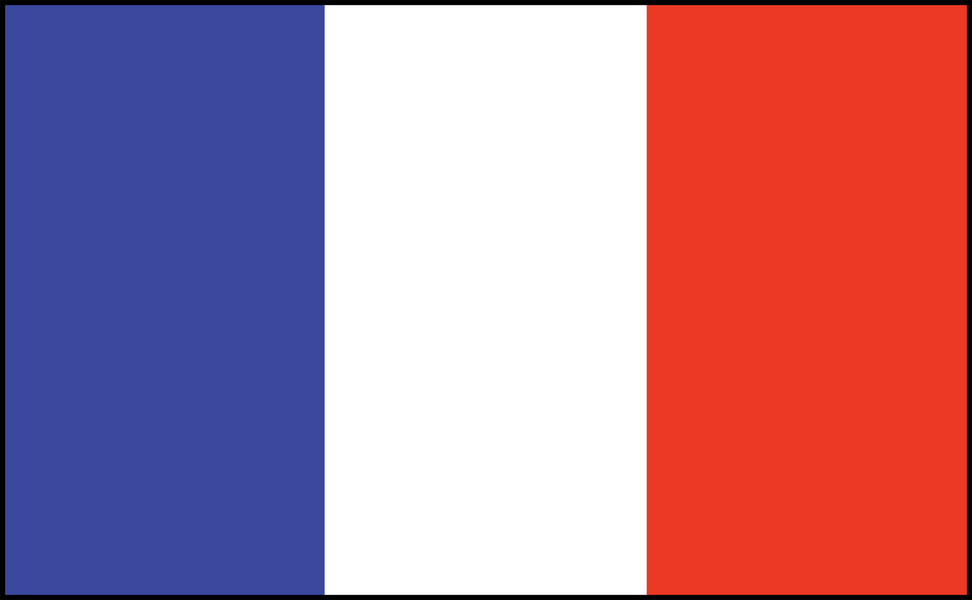
Three vertical bands of blue, white and red, known as the tricolore. Blue and red were the colours of Paris, and white was the colour of the French monarchy.
Putting the king's colour between the city's colours during the Revolution of 1789 was meant to show the monarchy contained by the people. The design has been copied by dozens of countries since, which is why so many national flags use three vertical bands.