
Finland
Finland is called the land of a thousand lakes, which undersells it badly: it actually has around 188,000 of them.
- CapitalHelsinkiThe northernmost EU capital on the mainland
- PopulationAbout 5.6 millionOne of the least densely populated in Europe
- Area338,455 km2Around 75 per cent forest
- LakesAbout 188,000More lakes per person than any country
Finland is mostly forest and water. Around three quarters is covered in trees, and the lakes, carved out by ice-age glaciers, are so numerous that the country has more of them per person than anywhere else. Roughly a quarter of Finland lies inside the Arctic Circle.
Finland has topped the World Happiness Report every year since 2018. Finns often put this down to trust in institutions, a strong welfare state and easy access to nature rather than to cheerfulness.
National symbols
- National animal Brown bear
- National bird Whooper swan
- National anthem Maamme (Translation: Our Land)
- National day Independence Day, 6 December
Map of Finland
Geography
Finland covers 338,455 km2 and borders Sweden, Norway and Russia, with the Baltic Sea, Gulf of Bothnia and Gulf of Finland to the south and west.
The land is low and gently rolling, scraped flat by ice-age glaciers that also left the lakes. The only real hills are in Lapland in the north-west, where Halti reaches 1,324 m. Around 180,000 islands lie off the south-west coast in the Archipelago Sea.
Climate
Finland has cold winters and short warm summers. Helsinki averages around minus 4C in winter and 20C in July, while Lapland regularly drops below minus 30C.
Lakes and the sea freeze over, and icebreakers keep the ports open. In Lapland the sun stays up for over two months in midsummer and stays down for weeks in midwinter, and the northern lights are visible on around 200 nights a year.
Culture
Finnish and Swedish are both official, with around 5 per cent of the population speaking Swedish as a first language. Sami languages are official in the far north.
The Finnish education system is admired worldwide for starting formal school at seven, setting little homework and having almost no standardised testing. Around 66 per cent of Finns belong to the Lutheran church. Sisu, meaning stubborn determination in the face of hardship, is a national concept.
Economy
Forestry has always been central: Finland is one of the largest exporters of paper, pulp and sawn timber in Europe.
Machinery, electronics and ships are the other pillars. Nokia dominated the world mobile phone market before smartphones, and Finland now has a strong games industry, producing Angry Birds and Clash of Clans.
The flag
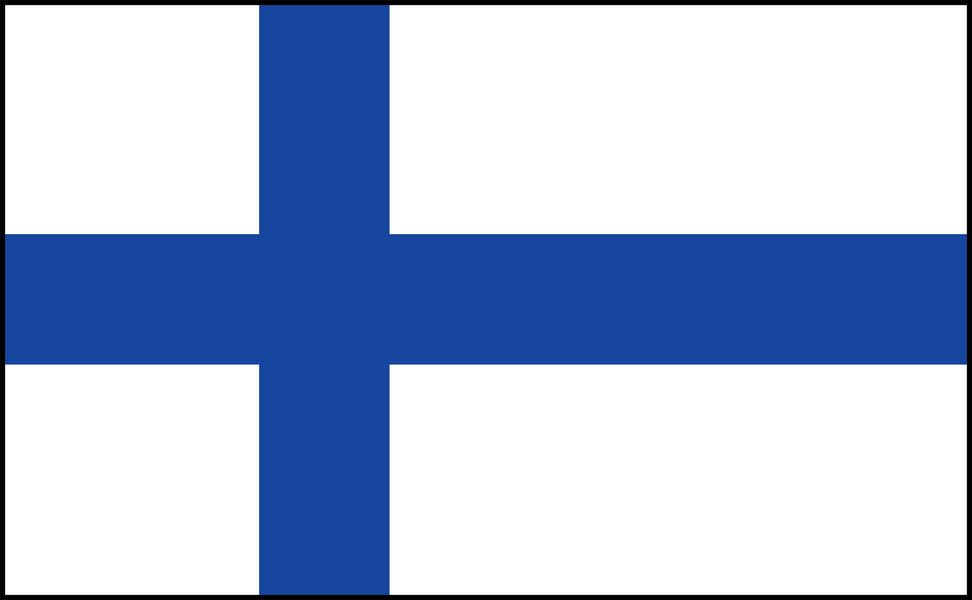
A white field with a blue Nordic cross, its vertical arm set towards the flagpole in the same layout as the other Nordic flags.
The blue stands for the country's thousands of lakes and the sky, and the white for the snow that covers the land for much of the year. The design was adopted in 1918, shortly after Finland became independent from Russia.