
Czech Republic
Czechs drink more beer per person than anyone else in the world, and the town of Pilsen gave its name to the pilsner lager now brewed everywhere.
- CapitalPragueIts historic centre survived the war almost intact
- PopulationAbout 10.9 millionLandlocked in central Europe
- Area78,871 km2Bohemia, Moravia and Czech Silesia
- BeerMost per person on EarthAround 180 litres a year
The Czech Republic, also called Czechia, is a landlocked country ringed by low mountains. Bohemia in the west is a basin surrounded by hills, and Moravia in the east is lower and more open.
Prague escaped the heavy bombing that flattened so many central European cities, so its medieval and baroque centre survives largely intact: the astronomical clock, Charles Bridge and the castle above the river are all originals.
National symbols
- National animal Double-tailed lion
- National flower Small-leaved lime
- National anthem Kde domov muj (Translation: Where Is My Home)
- National day Czech Statehood Day, 28 September
Map of Czech Republic
Geography
The Czech Republic covers 78,871 km2 and borders Germany, Poland, Slovakia and Austria. It is landlocked.
Bohemia in the west is a basin ringed by low mountain ranges, and Moravia in the east is lower and more open. The highest point is Snezka at 1,603 m in the Krkonose mountains. The Elbe and Vltava are the main rivers.
Climate
The country has a temperate continental climate with warm summers and cold winters. Prague averages around 0C in January and 19C in July.
The mountains along the borders get significant snow and support skiing. Rainfall is moderate and spread through the year, with the highest amounts in the border ranges.
Culture
Czech is the official language, a Slavic language written in the Latin alphabet with a distinctive set of accent marks. The letter r with a hacek is a sound found in almost no other language.
Czechia has produced Dvorak and Smetana in music, Kafka in literature and Vaclav Havel, a playwright who became president. Around 47 per cent of Czechs report no religion, one of the highest shares in Europe. Puppet theatre is a strong national tradition.
Economy
The Czech Republic is highly industrialised. Cars are the biggest export, with Skoda based at Mlada Boleslav, and the country produces more cars per person than almost anywhere.
Machinery, electronics and glass are also important: Bohemian crystal has been made here for centuries. Tourism to Prague brings millions of visitors a year.
The flag
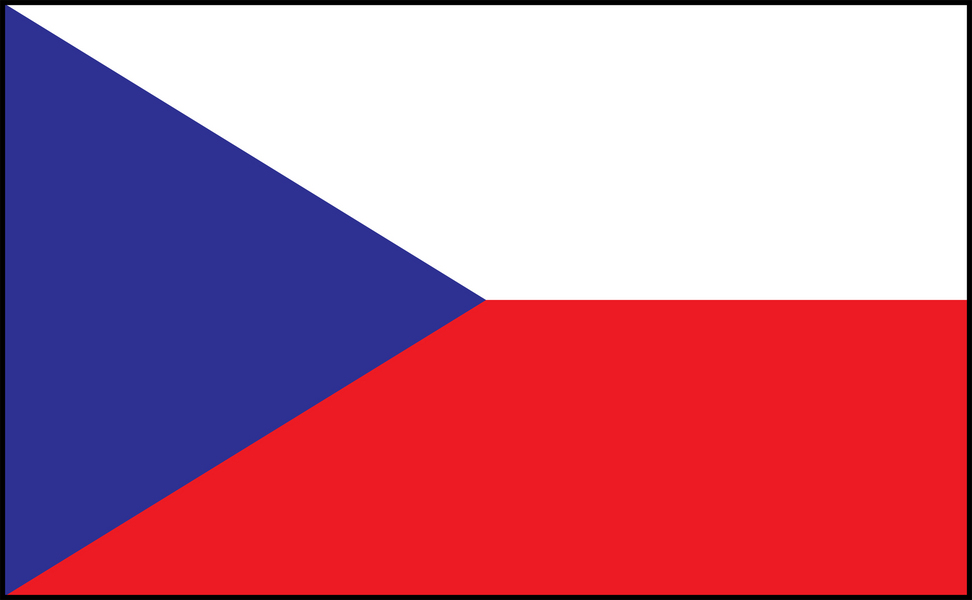
A white band above a red band, with a blue triangle reaching in from the flagpole side to the centre of the flag.
White and red were the colours of Bohemia. The blue triangle was added in 1920 to represent Slovakia and Moravia, and to distinguish the flag from Poland's. When Czechoslovakia split in 1993 the Czech Republic kept the flag, even though the agreement said neither country would use the old symbols.