
Cyprus
Cyprus has been divided since 1974, with a United Nations buffer zone running right through the middle of its capital.
- CapitalNicosiaThe last divided capital city in Europe
- PopulationAbout 1.3 millionAcross the whole island
- Area9,251 km2Third largest Mediterranean island
- Divided since1974By a UN-patrolled buffer zone
Cyprus is the third largest island in the Mediterranean, closer to Turkey and Syria than to Greece. Two mountain ranges cross it, and between them lies the flat Mesaoria plain.
In 1974, after a coup backed by Greece, Turkey invaded the north. The island has been divided ever since. The Republic of Cyprus controls the south and is in the EU; the north is administered as the Turkish Republic of Northern Cyprus, recognised only by Turkey. A UN buffer zone, the Green Line, runs across the island and through Nicosia.
National symbols
- National animal Cyprus mouflon, a wild mountain sheep
- National flower Cyclamen
- National anthem Hymn to Liberty, shared with Greece
- National day Independence Day, 1 October
Map of Cyprus
Geography
Cyprus covers 9,251 km2 and has no land borders, lying in the eastern Mediterranean about 70 km south of Turkey.
The Troodos Mountains fill the centre and south-west, rising to Mount Olympus at 1,952 m, which gets enough snow for a small ski resort. The narrow Kyrenia range runs along the north coast, and the Mesaoria plain lies between them.
Climate
Cyprus has a hot Mediterranean climate with long dry summers, often above 35C inland, and mild wet winters. It is one of the sunniest places in Europe, with around 320 sunny days a year.
Water is scarce. Rainfall falls almost entirely between November and March, and the island depends heavily on reservoirs and desalination plants.
Culture
Greek and Turkish are both official languages. Around 78 per cent of the population is Greek Cypriot and around 18 per cent Turkish Cypriot, though the two now live largely separated.
Halloumi, a squeaky cheese that can be grilled without melting, is Cypriot and has EU protected status. Around 73 per cent of Cypriots are Greek Orthodox Christian and around 18 per cent Muslim.
Economy
Services dominate: tourism, shipping and financial services. Cyprus has one of the largest ship registries in the world.
Halloumi, potatoes and citrus are the main agricultural exports. Large natural gas fields have been found offshore, though developing them is complicated by disputes over maritime boundaries.
The flag
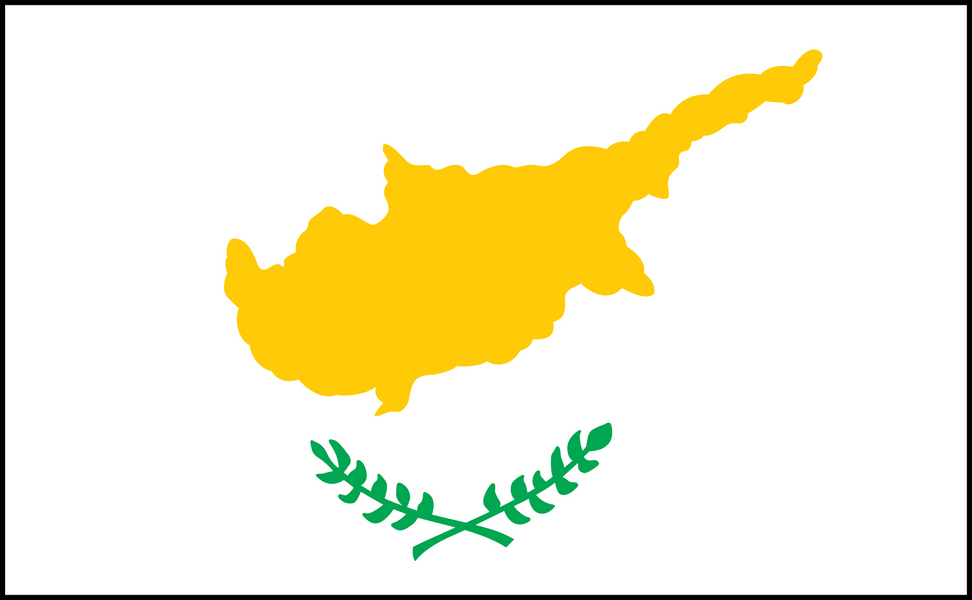
A white field with a copper-orange silhouette map of the island in the centre, above two crossed green olive branches.
The colour is copper, for the metal that gave the island its name. The olive branches stand for peace between the Greek and Turkish communities, and the flag deliberately avoids blue and red, the colours of Greece and Turkey. Cyprus is one of only two countries with a map on its flag.