
Croatia
Croatia has 1,244 islands along its Adriatic coast, and the necktie was invented here.
- CapitalZagrebInland, away from the tourist coast
- PopulationAbout 3.9 millionShaped like a crescent or boomerang
- Islands1,244Only around 50 are inhabited
- CurrencyEuroAdopted in January 2023
Croatia is an odd crescent shape, wrapping around Bosnia and Herzegovina. One arm runs inland through flat farmland towards Hungary, and the other runs down the Adriatic coast in a long thin strip backed by mountains.
That coast is the country's treasure: clear water, 1,244 islands, and walled cities including Dubrovnik, whose complete medieval walls made it a filming location for Game of Thrones.
National symbols
- National animal Pine marten, which gave its name to the old currency, the kuna
- National flower Iris croatica
- National anthem Lijepa nasa domovino (Translation: Our Beautiful Homeland)
- National day Statehood Day, 30 May
Map of Croatia
Geography
Croatia covers 56,594 km2 and borders Slovenia, Hungary, Serbia, Bosnia and Herzegovina and Montenegro, with a long Adriatic coastline to the west and south.
The Dinaric Alps run parallel to the coast and reach Dinara at 1,831 m. The limestone here is riddled with caves and sinkholes, a landscape geologists call karst after a region in this part of Europe. The Pannonian plain in the north-east is flat and fertile.
Climate
The coast has a Mediterranean climate with hot dry summers and mild wet winters, which is why it fills with tourists in July and August.
Inland the climate is continental, with colder winters and snow in Zagreb and the mountains. A fierce cold wind called the bura blows down from the mountains to the sea and can reach hurricane strength.
Culture
Croatian is the official language, a South Slavic language written in the Latin alphabet.
Klapa, a form of unaccompanied close-harmony singing from Dalmatia, is on the UNESCO heritage list. Around 79 per cent of Croatians are Catholic. Football matters enormously: Croatia reached the World Cup final in 2018 with a population smaller than many single cities.
Economy
Tourism dominates, worth around a fifth of the whole economy. The Adriatic coast, national parks and historic cities draw well over 15 million visitors a year.
Shipbuilding, food processing and pharmaceuticals are the main industries. Croatia joined the EU in 2013 and adopted the euro and joined the Schengen area in January 2023.
The flag
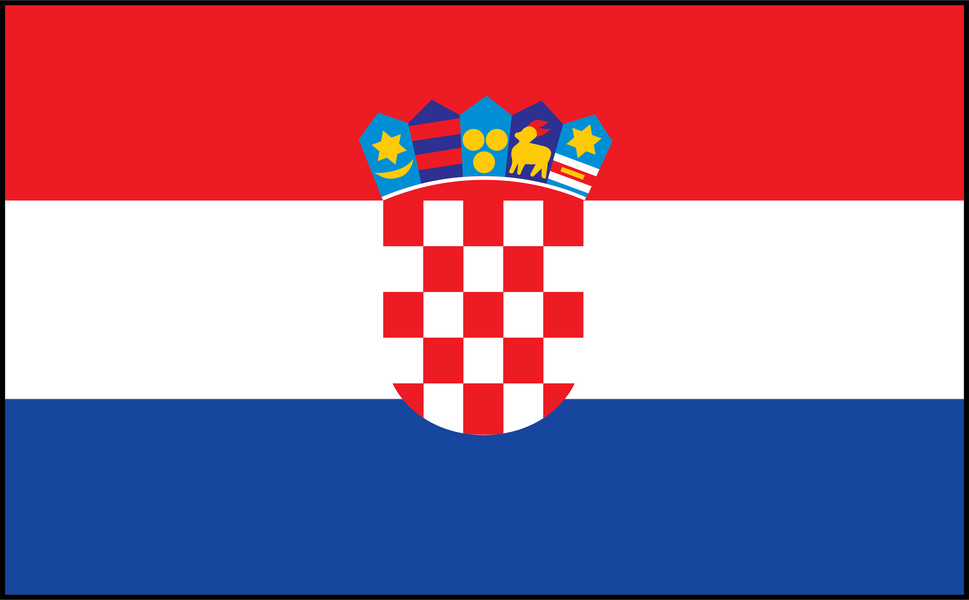
Three horizontal bands of red, white and blue, the pan-Slavic colours, with the national coat of arms sitting across the centre.
The shield is chequered red and white in a pattern Croatians call the sahovnica, meaning chessboard, used since the 1400s. Above it sit five smaller shields for the historic Croatian regions: Croatia, Dubrovnik, Dalmatia, Istria and Slavonia.