
Belarus
Belarus contains the last large stretch of primeval forest in Europe, where wild European bison still roam.
- CapitalMinskAlmost entirely rebuilt after the Second World War
- PopulationAbout 9.2 millionLandlocked in eastern Europe
- Area207,600 km2Around 40 per cent forest
- BisonEuropean bisonEurope's heaviest land animal, saved from extinction here
Belarus is flat, forested and full of marshes. The Pripet Marshes in the south are one of the largest wetlands in Europe. Around 40 per cent of the country is woodland, and there are more than 10,000 lakes.
Bialowieza Forest, shared with Poland, is the last major remnant of the primeval forest that once covered the whole of the European plain. It is the stronghold of the European bison, which went extinct in the wild in 1927 and was brought back from zoo animals.
National symbols
- National animal European bison
- National flower Flax flower
- National anthem My Belarusy (Translation: We Belarusians)
- National day Independence Day, 3 July
Map of Belarus
Geography
Belarus covers 207,600 km2 and borders Russia, Ukraine, Poland, Lithuania and Latvia. It is landlocked.
The land is flat and low, shaped by glaciers, with the highest point only 345 m. Forest covers around 40 per cent of the country and the Pripet Marshes in the south form one of Europe's largest wetlands. There are over 10,000 lakes.
Climate
Belarus has a continental climate with cold, snowy winters and warm summers. Minsk averages around minus 5C in January and 18C in July.
Snow lies for around three to four months. Rainfall is moderate, mostly in summer, and the flat land and heavy soils mean spring meltwater floods are common.
Culture
Belarusian and Russian are both official, though Russian is more widely used in daily life and Belarusian is considered vulnerable by UNESCO.
Straw weaving, making figures and decorations from rye straw, is a distinctive folk craft. Around 74 per cent of Belarusians are Orthodox Christian. Ice hockey is the most popular sport, and Belarus has a strong gymnastics tradition.
Economy
The economy remains heavily state-controlled, with large factories inherited from the Soviet period. Potash fertiliser, refined oil products, tractors and heavy trucks are the main exports.
BelAZ, based in Zhodino, builds some of the largest dump trucks in the world, capable of carrying 450 tonnes. Agriculture produces potatoes, dairy and flax.
The flag
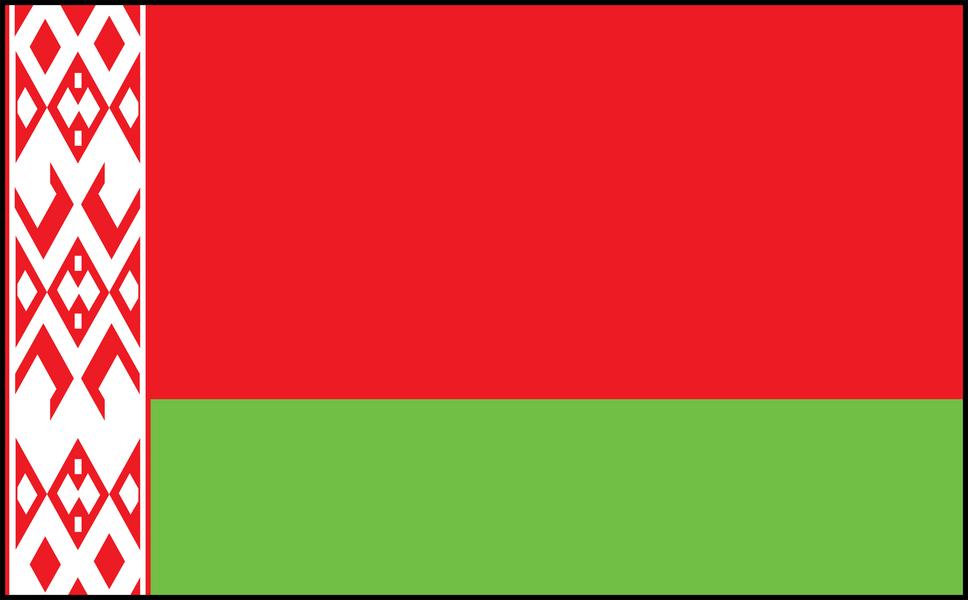
A red band across the top two thirds and a green band below, with a vertical strip of red pattern on white running down the flagpole side.
That pattern is a traditional Belarusian woven ornament, taken from an embroidered design made by a peasant woman in 1917. Red stands for the past and for the blood shed in war, and green for the forests and fields. Opposition movements use a different white-red-white flag instead.