
Austria
Austria produced Mozart, Haydn and Schubert, and roughly two thirds of the country is covered by the Alps.
- CapitalViennaRegularly voted the most liveable city in the world
- PopulationAbout 9.1 millionAcross nine federal states
- Area83,879 km2Around two thirds mountainous
- Highest pointGrossglockner, 3,798 mIn the Hohe Tauern range
Austria is a landlocked alpine country in central Europe. The Alps run across the west and south, and the flatter east around Vienna and the Danube is where most people live and most farming happens.
For centuries Vienna was the capital of the Habsburg empire, which ruled much of central Europe. That is why the city has such grand palaces and such a musical tradition: Mozart, Haydn, Schubert, Strauss and Mahler all worked here.
National symbols
- National animal Black eagle
- National flower Edelweiss
- National anthem Land der Berge, Land am Strome (Translation: Land of Mountains, Land by the River)
- National day National Day, 26 October
Map of Austria
Geography
Austria covers 83,879 km2 and borders eight countries: Germany, the Czech Republic, Slovakia, Hungary, Slovenia, Italy, Switzerland and Liechtenstein. It is landlocked.
The Alps cover the western two thirds, rising to the Grossglockner at 3,798 m. The Danube crosses the north from west to east, and its valley and the plains around Vienna hold most of the population and farmland.
Climate
Austria has a temperate central European climate with warm summers and cold, snowy winters, and altitude changes everything: the high Alps stay below freezing for much of the year and hold glaciers.
The east around Vienna is drier and more continental, with hotter summers. The fohn, a warm dry alpine wind, can raise temperatures suddenly in the mountain valleys.
Culture
German is the official language, spoken in Austrian dialects that differ noticeably from those of Germany. Croatian, Slovene and Hungarian have official status in some regions.
Coffee house culture in Vienna is on the UNESCO heritage list: places where you can sit for hours over one coffee with a newspaper. Sachertorte, a dense chocolate cake, was invented in Vienna. Around 68 per cent of Austrians are Christian, mostly Catholic.
Economy
Austria has a strong, high-wage economy built on machinery, steel, vehicles and chemicals, much of it supplying German industry.
Tourism is a major earner in both seasons: skiing in the Alps in winter, hiking and lakes in summer. Austria generates a very high share of its electricity from hydroelectric dams on alpine rivers.
The flag
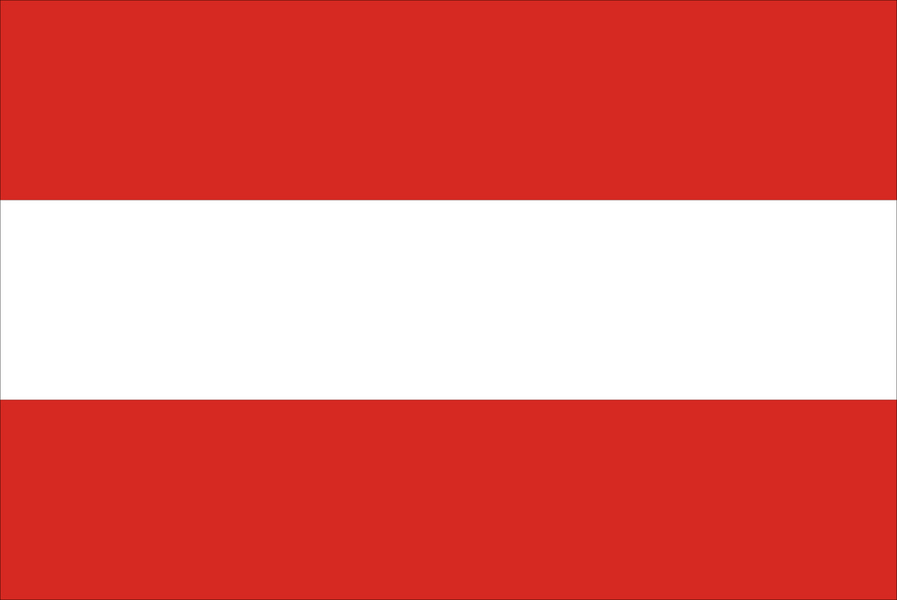
Three horizontal bands of red, white and red. It is one of the oldest national flags in the world, with the design traced back to the 1200s.
The legend says Duke Leopold V fought so hard during a crusade that his white tunic was soaked in blood, except for a band under his belt which stayed white. He took the pattern as his emblem, and Austria has used it ever since.