
Albania
Albania has around 173,000 concrete bunkers scattered across the countryside, built by a dictator who feared invasion from everywhere at once.
- CapitalTiranaBuildings painted in bright colours to lift the city
- PopulationAbout 2.8 millionPlus a large diaspora abroad
- Area28,748 km2Around 70 per cent mountainous
- BunkersAbout 173,000Roughly one for every 11 people at the time
Albania sits on the Adriatic and Ionian coasts opposite the heel of Italy, and around 70 per cent of it is mountainous. Its coastline, called the Albanian Riviera in the south, has clear water and beaches that stayed almost unknown to outsiders for decades.
From 1944 to 1985 Albania was ruled by Enver Hoxha, one of the most isolated communist dictators in Europe. Convinced the country would be invaded, he ordered concrete bunkers built everywhere. Many still sit in fields, on beaches and in gardens, some converted into cafes and museums.
National symbols
- National animal Golden eagle
- National flower Red poppy
- National anthem Himni i Flamurit (Translation: Hymn to the Flag)
- National day Independence Day, 28 November
Map of Albania
Geography
Albania covers 28,748 km2 and borders Montenegro, Kosovo, North Macedonia and Greece, with the Adriatic and Ionian Seas to the west.
Around 70 per cent of the country is mountainous, rising to Korab at 2,764 m on the North Macedonian border. The Albanian Alps in the north are steep and remote. Lake Ohrid, shared with North Macedonia, is one of the oldest lakes in the world at around 2 million years.
Climate
The coast has a Mediterranean climate with hot dry summers and mild wet winters. Inland and in the mountains it becomes continental, with cold snowy winters.
The mountains catch heavy rain and snow, and some of the highest rainfall totals in Europe are recorded in the Albanian Alps, over 3,000 mm a year in places.
Culture
Albanian is the official language. Besa, a code of honour meaning to keep a promise, is a defining cultural concept: during the Second World War it led Albanians to shelter Jewish refugees, and Albania ended the war with more Jews than it started with.
Around 57 per cent of Albanians are Muslim and around 17 per cent Christian, but religious identity is generally held lightly and mixed families are common. Iso-polyphony, a form of multi-part folk singing, is on the UNESCO heritage list.
Economy
Albania is one of the poorer countries in Europe but has grown steadily. Tourism has expanded quickly as the Riviera coastline has become known abroad.
Agriculture employs a large share of the workforce, producing olives, citrus, grapes and vegetables. Chrome, oil, hydroelectric power and money sent home from Albanians working in Italy, Greece and further afield are the other main sources of income.
The flag
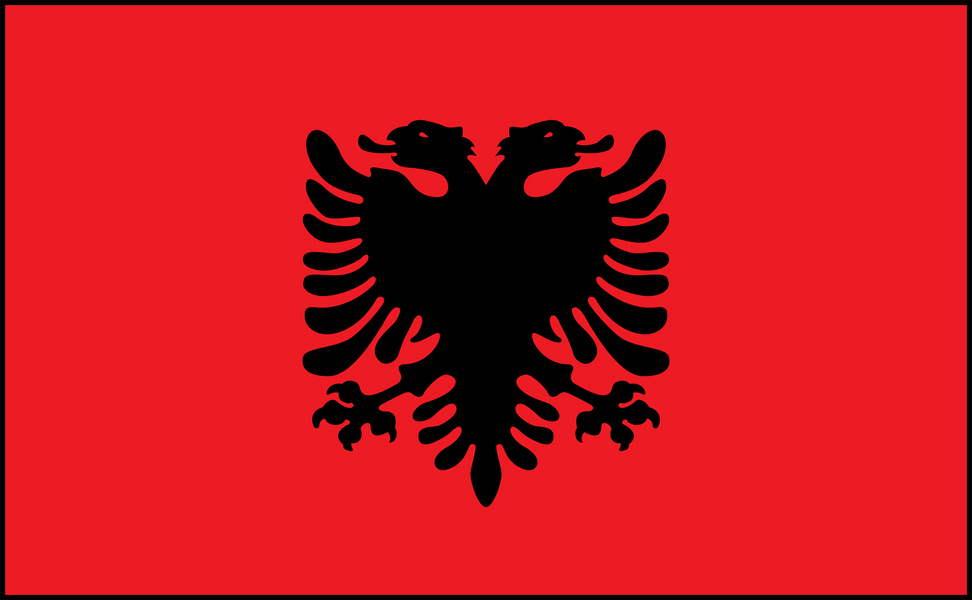
A plain red field with a black double-headed eagle in the centre, wings spread. It is one of the most striking and simplest national flags in Europe.
The eagle comes from the seal of Skanderbeg, the national hero who led resistance against the Ottoman Empire in the 1400s. Albanians call their country Shqiperia, often translated as land of the eagles.