
Yemen
Yemen has mud-brick tower houses up to eight storeys high, built centuries ago, which is why one of its cities is called the Manhattan of the Desert.
- CapitalSana'aOne of the oldest continuously inhabited cities
- PopulationAbout 34 millionOn the southern Arabian Peninsula
- Area527,968 km2Mountains, desert and coast
- SocotraA UNESCO siteA third of its plants grow nowhere else
Yemen occupies the south-western corner of the Arabian Peninsula. Unlike most of its neighbours it has real mountains, rising above 3,600 m, and enough monsoon rain on their western slopes to support terraced farming that has been worked for thousands of years.
Shibam in the Hadhramaut valley is a walled city of mud-brick tower houses, some eight storeys tall, built in the 16th century. It is often called the oldest example of vertical city planning in the world.
National symbols
- National bird Golden eagle
- National plant Coffee plant, and the dragon's blood tree of Socotra
- National anthem United Republic
- National day Unity Day, 22 May
Map of Yemen
Geography
Yemen covers 527,968 km2 and borders Saudi Arabia and Oman, with the Red Sea to the west and the Gulf of Aden and Arabian Sea to the south.
Mountains run along the west, rising to Jabal An-Nabi Shu'ayb at 3,666 m, the highest point in Arabia. East of them lie desert plateaus and part of the Rub al Khali. Socotra, in the Arabian Sea, is around 350 km from the mainland.
Climate
Most of Yemen is hot desert, but the western mountains catch monsoon rain in summer and are noticeably cooler and greener than the rest of the peninsula.
Sana'a, at around 2,250 m, has a temperate climate all year despite being in Arabia. The coastal plains are extremely hot and humid, and rainfall away from the mountains is minimal.
Culture
Arabic is the official language, spoken in Yemeni dialects. On Socotra, an unrelated ancient South Arabian language called Soqotri is still spoken.
Nearly all Yemenis are Muslim. The jambiya, a curved dagger worn at the belt, is a traditional mark of status for men. The old city of Sana'a, with its distinctive tower houses decorated in white gypsum patterns, is a UNESCO World Heritage Site.
Economy
Yemen is the poorest country in the Arabian Peninsula, and the war since 2014 has caused one of the world's worst humanitarian crises.
Oil and gas were the main exports before the conflict. Agriculture supports many people, growing coffee, sorghum, dates and, controversially, qat, a mildly stimulant leaf that consumes a large share of the country's scarce water.
The flag
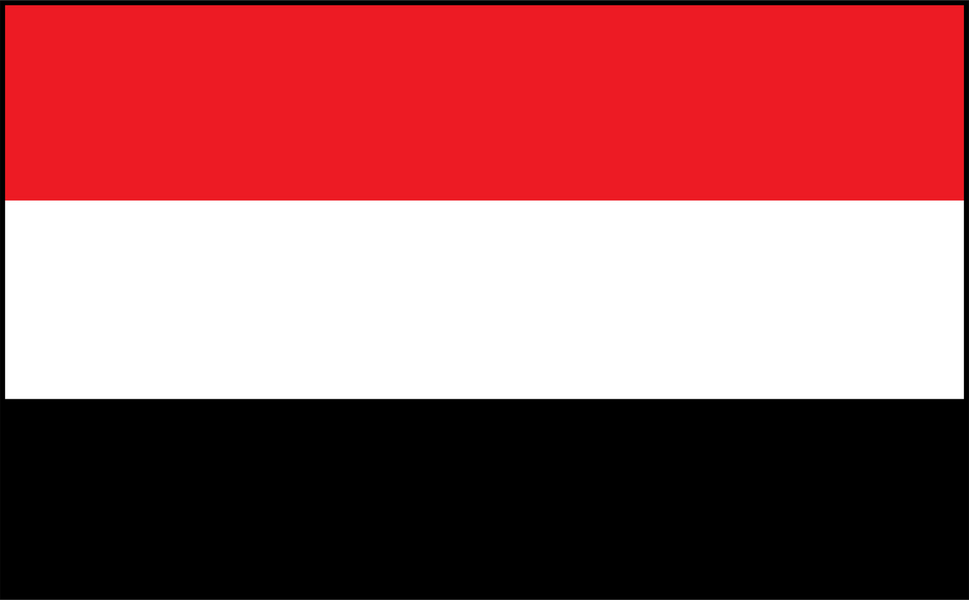
Three plain horizontal bands of red, white and black, with no emblem, making it one of the simplest flags in the world.
These are the pan-Arab colours: red for the blood of martyrs and the struggle for unity, white for a bright future, and black for the dark days of the past. The flag was adopted in 1990 when North and South Yemen united.