
Vietnam
Vietnam contains the largest cave passage in the world, big enough to hold an entire New York City block including 40-storey buildings.
- CapitalHanoiIn the Red River delta in the north
- PopulationAbout 100 millionLong and narrow along the coast
- Area331,212 km2Over 3,200 km of coastline
- Son Doong caveLargest cave passage on EarthDiscovered in 1991
Vietnam is a long S-shaped country running down the eastern edge of mainland Southeast Asia. It is at points only about 50 km wide. Two great rice-growing deltas anchor it: the Red River in the north and the Mekong in the south, with mountains and a narrow coastal strip between.
Son Doong, found in 1991 and first explored in 2009, is the largest known cave passage in the world. It has its own jungle, its own weather system with clouds forming inside, and a river running through it.
National symbols
- National animal Water buffalo, and the dragon in tradition
- National flower Lotus
- National anthem Tien Quan Ca (Translation: Army March)
- National day National Day, 2 September
Map of Vietnam
Geography
Vietnam covers 331,212 km2 and borders China, Laos and Cambodia, with the South China Sea, which Vietnam calls the East Sea, along its entire eastern side.
Mountains and hills cover around three quarters of the country, rising to Fansipan at 3,147 m in the north-west. The Red River delta in the north and the Mekong delta in the south are flat, fertile and intensively farmed, producing most of the country's rice.
Climate
Vietnam is tropical in the south and subtropical in the north, so the two ends have quite different weather. Hanoi has a cool winter, while Ho Chi Minh City is hot all year.
The monsoon brings heavy rain, roughly May to September in the south and later in the centre. Typhoons strike the central coast most years, and the Mekong Delta is vulnerable to flooding and rising sea levels.
Culture
Vietnamese is the official language and is written in the Latin alphabet with a dense set of accent marks, a system developed by European missionaries in the 1600s. It is a tonal language with six tones.
Around 86 per cent of Vietnamese people report no religion or follow folk traditions, with Buddhism widely practised. Pho, a beef or chicken noodle soup, is the national dish. Water puppetry, performed on a flooded stage, is a Vietnamese art form around a thousand years old.
Economy
Vietnam has grown very fast since market reforms in 1986. Electronics assembly is now the largest export sector: a significant share of the world's smartphones is made here.
Textiles, footwear and furniture are major exports. Vietnam is also the second largest coffee exporter and one of the largest rice exporters in the world, along with substantial seafood and cashew nut exports.
The flag
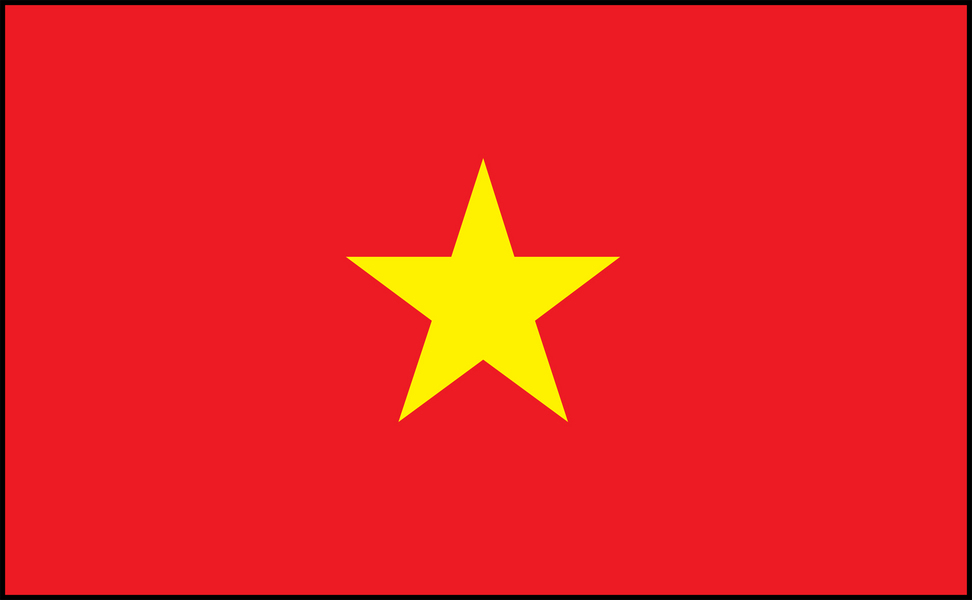
A plain red field with a single large yellow five-pointed star in the centre.
Red stands for revolution and the blood shed in the long struggle for independence. The five points of the star are usually said to represent the five groups that built the nation: workers, farmers, soldiers, intellectuals and traders.