
Uzbekistan
Uzbekistan is one of only two doubly landlocked countries in the world, and the Silk Road cities of Samarkand and Bukhara sit inside it.
- CapitalTashkentThe largest city in Central Asia
- PopulationAbout 36 millionThe most populous Central Asian country
- Area448,978 km2Mostly desert and steppe
- Doubly landlockedOne of only twoThe other is Liechtenstein
Uzbekistan sits in the middle of Central Asia, surrounded entirely by other landlocked countries, which makes it one of only two doubly landlocked nations on Earth. Most of it is the Kyzylkum Desert and dry steppe, with mountains in the east.
The Silk Road ran straight through it, and the trading cities that grew rich on it survive: Samarkand, with the vast tiled Registan square, Bukhara and Khiva. Their turquoise domes and glazed tilework are among the finest Islamic architecture anywhere.
National symbols
- National bird Khumo, a mythical bird of happiness
- National flower Cotton flower
- National anthem National Anthem of the Republic of Uzbekistan
- National day Independence Day, 1 September
Map of Uzbekistan
Geography
Uzbekistan covers 448,978 km2 and borders Kazakhstan, Kyrgyzstan, Tajikistan, Afghanistan and Turkmenistan. All five of its neighbours are themselves landlocked, making it doubly landlocked.
The Kyzylkum Desert fills much of the centre and north. The Tian Shan and Pamir foothills rise in the east, and the fertile Fergana Valley there holds a large share of the population. The Amu Darya and Syr Darya rivers cross the country.
Climate
Uzbekistan has a continental desert climate: very hot dry summers, often above 40C, and cold winters that can drop well below freezing.
Rainfall is low, mostly in winter and spring, and the country depends heavily on river water and irrigation. That irrigation is what drained the Aral Sea in the north-west.
Culture
Uzbek is the official language, a Turkic language now written in the Latin alphabet, and Russian is widely used. Tajik, a Persian language, is spoken in Samarkand and Bukhara.
Around 88 per cent of Uzbeks are Muslim. Plov, a rice dish cooked with lamb, carrots and onions in a large cast-iron pot, is the national dish and its preparation is on the UNESCO heritage list. Suzani embroidery and ikat silk weaving are traditional crafts.
Economy
Cotton has long been the dominant crop, so much so that Uzbekistan is nicknamed the land of white gold, though the country has been reducing its cotton area because of the water it consumes.
Gold mining is significant, and the Muruntau mine is one of the largest open-pit gold mines in the world. Natural gas, copper and a fast-growing tourist industry built on the Silk Road cities complete the picture.
The flag
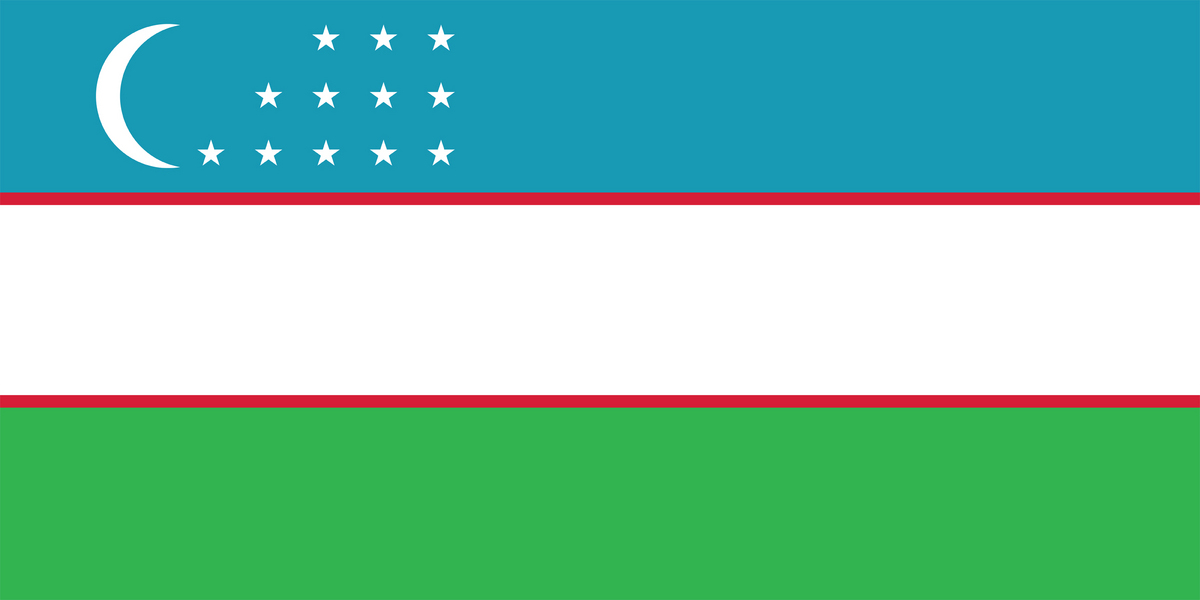
Three horizontal bands of blue, white and green, separated by thin red stripes, with a white crescent moon and twelve white stars in the upper left.
Blue stands for the sky and water and echoes the banner of Timur, the medieval conqueror. White is peace, green is nature and fertility, and the thin red lines stand for the life force. The crescent represents the rebirth of the nation, and the twelve stars the months of the Uzbek solar calendar.