
United Arab Emirates
The United Arab Emirates has the tallest building in the world, the Burj Khalifa, standing 828 m high in what was desert 60 years ago.
- CapitalAbu DhabiThe largest of the seven emirates
- PopulationAbout 9.5 millionAround 88 per cent are foreign nationals
- Area83,600 km2Mostly desert
- Burj Khalifa828 mThe tallest building in the world
The UAE is a federation of seven emirates on the south-eastern edge of the Arabian Peninsula, formed in 1971. Abu Dhabi is the largest by far and holds most of the oil; Dubai is the best known and built its wealth on trade and tourism instead.
Sixty years ago this was a region of small pearl-diving and trading settlements. Oil money transformed it in a single generation into a country of skyscrapers, artificial islands and international airports.
National symbols
- National animal Arabian oryx, and the falcon as national bird
- National plant Date palm, and the ghaf tree
- National anthem Ishy Bilady (Translation: Long Live My Nation)
- National day National Day, 2 December
Map of United Arab Emirates
Geography
The UAE covers 83,600 km2 and borders Saudi Arabia and Oman, with the Persian Gulf to the north and the Gulf of Oman to the east.
Most of the country is sand desert, part of the Rub al Khali in the south. The Hajar Mountains rise in the east near the Omani border, reaching around 1,900 m. The coast has many low islands, and more have been built artificially, including the Palm Jumeirah.
Climate
The UAE has a hot desert climate. Summer temperatures regularly exceed 45C, and coastal humidity makes it feel worse, so much of daily life moves indoors and underground.
Winters are pleasant, around 20C to 28C, which is the main tourist season. Rain is rare, under 100 mm a year, and the country now uses cloud seeding to try to increase it.
Culture
Arabic is the official language, but because so much of the population is foreign, English is the everyday working language, along with Hindi, Urdu, Malayalam and Tagalog.
Islam is the state religion and around 76 per cent of the population is Muslim. Falconry and camel racing remain important traditions, and camel races now sometimes use small robot jockeys. Traditional dhow sailing boats are still built by hand.
Economy
Oil and gas built the country, mostly from Abu Dhabi, and still fund a large part of government spending.
Dubai deliberately diversified into trade, aviation, finance and tourism. Emirates airline and Dubai International Airport made the city one of the world's busiest transfer hubs, and Jebel Ali is the largest man-made harbour in the world.
The flag
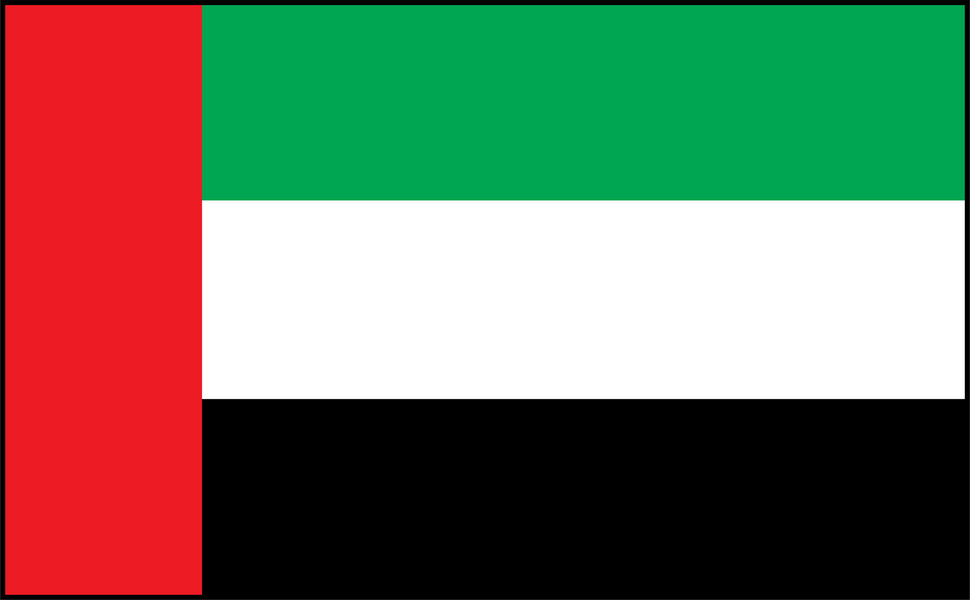
Three horizontal bands of green, white and black, with a vertical red band along the flagpole edge. These are the pan-Arab colours.
Green stands for fertility, white for neutrality and peace, black for the strength of the mind and for oil, and red for unity and the sacrifices made for the country. The flag was adopted on the day the federation was formed in 1971.