
Turkmenistan
Turkmenistan has a gas crater in the desert that has been burning continuously since 1971, nicknamed the Door to Hell.
- CapitalAshgabatHolds a record for the most white marble buildings
- PopulationAbout 6.5 millionLandlocked in Central Asia
- Area488,100 km2Around 80 per cent desert
- Darvaza craterBurning since 1971Nicknamed the Door to Hell
Turkmenistan is around 80 per cent desert. The Karakum, meaning black sand, fills the centre of the country, and most people live around its edges where rivers and canals provide water.
At Darvaza, a Soviet drilling rig collapsed into a gas cavern in 1971. Engineers set the escaping gas alight expecting it to burn off in weeks. It has been burning ever since, a crater 70 m across glowing orange in the middle of the desert.
National symbols
- National animal Akhal-Teke horse
- National plant Wheat, shown on the emblem
- National anthem National Anthem of Independent Neutral Turkmenistan
- National day Independence Day, 27 September
Map of Turkmenistan
Geography
Turkmenistan covers 488,100 km2 and borders Kazakhstan, Uzbekistan, Afghanistan and Iran, with a Caspian Sea coast to the west.
The Karakum Desert covers around 80 per cent of the country. The Kopet Dag mountains run along the Iranian border, and the Amu Darya crosses the east. The Karakum Canal, one of the longest irrigation canals in the world, carries river water across the desert.
Climate
Turkmenistan has an extreme desert climate with very hot summers, regularly above 40C and sometimes reaching 50C in the Karakum, and cold winters.
Rainfall is very low, under 200 mm a year in most places and far less in the desert interior. The country depends almost entirely on river water carried through canals for its farming.
Culture
Turkmen is the official language, a Turkic language written in the Latin alphabet since 1993. Russian is still widely understood.
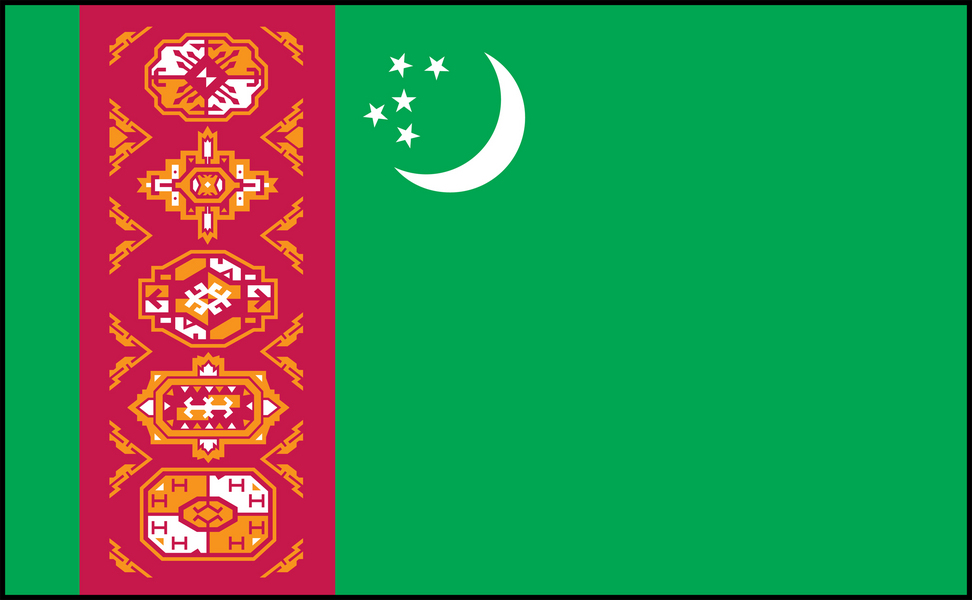
Around 93 per cent of Turkmen are Muslim. Turkmen carpets, hand-knotted in deep red with distinctive tribal patterns called guls, are a national art form and appear on the flag. The country has been very closed to outsiders since independence.
Economy
Natural gas dominates. Turkmenistan has some of the largest reserves in the world, including the Galkynysh field, and exports most of it to China.
Cotton is the main crop, grown with irrigated water from the Karakum Canal. The economy is state-controlled and heavily dependent on gas prices.
The flag
A green field with a white crescent moon and five white stars in the upper left, and a vertical red stripe near the flagpole carrying five carpet patterns.
The five carpet guls stand for the five traditional Turkmen tribes and the five regions of the country. Below them are two crossed olive branches, added in 1997 to mark Turkmenistan's official policy of permanent neutrality. The crescent and stars represent Islam and a bright future.