
Tajikistan
Tajikistan is over 90 per cent mountains, and one of its ranges is nicknamed the Roof of the World.
- CapitalDushanbeThe name means Monday, after its market day
- PopulationAbout 10 millionLandlocked in Central Asia
- Area143,100 km2Over 90 per cent mountainous
- PamirsThe Roof of the WorldPeaks above 7,000 m
Tajikistan is the most mountainous country in Central Asia. The Pamir range in the east, known as the Roof of the World, has peaks above 7,000 m and one of the longest non-polar glaciers on Earth, the Fedchenko, around 77 km long.
The Pamir Highway, running through those mountains at altitudes over 4,600 m, is one of the highest roads in the world and follows an ancient Silk Road branch.
National symbols
- National animal Marco Polo sheep, with enormous spiral horns
- National flower Tulip
- National anthem Surudi Milli (Translation: National Anthem)
- National day Independence Day, 9 September
Map of Tajikistan
Geography
Tajikistan covers 143,100 km2 and borders Uzbekistan, Kyrgyzstan, China and Afghanistan. It is landlocked.
Over 90 per cent of the country is mountainous. Ismoil Somoni Peak in the Pamirs reaches 7,495 m, the highest point in the former Soviet Union. The Fedchenko Glacier is one of the longest outside the polar regions. Lowland farming is concentrated in the Fergana and Vakhsh valleys.
Climate
Tajikistan has a continental climate that varies sharply with altitude. Lowland valleys are hot in summer, above 35C, and mild in winter.
The Pamirs are cold and dry all year, with parts of the eastern plateau classed as high-altitude desert. Snowmelt from the mountains feeds the rivers that irrigate much of Central Asia.
Culture
Tajik is the official language, a variety of Persian written in Cyrillic. Russian is widely used in business and government.
Around 96 per cent of Tajikistanis are Muslim. Navruz, the Persian new year at the spring equinox, is the biggest festival of the year. Tajik traditions of poetry and music share a heritage with Iran and Afghanistan, and the shashmaqam musical tradition is UNESCO-listed.
Economy
Tajikistan is the poorest country in Central Asia. Aluminium smelting and cotton are the traditional industries, both inherited from the Soviet period.
Hydroelectric power is a major asset, and the Rogun Dam under construction is intended to become the tallest in the world. Money sent home by Tajiks working in Russia accounts for a very large share of the economy.
The flag
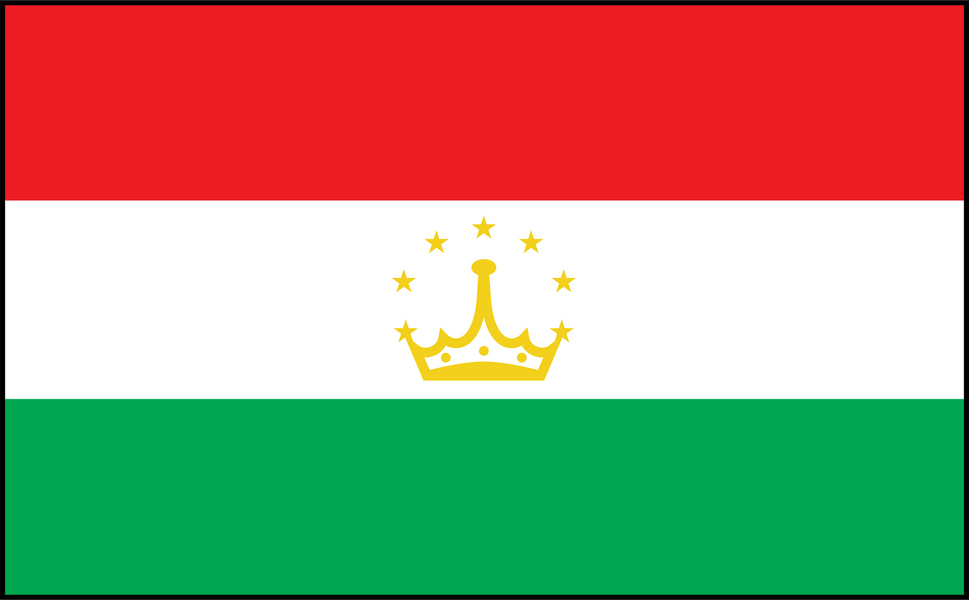
Three horizontal bands of red, white and green, with the white band the widest, carrying a gold crown beneath an arc of seven gold stars.
Red stands for the unity of the nation and for victory, white for cotton and the snow of the mountains, and green for the valleys and Islam. The crown represents the Tajik people, and the seven stars reflect a Tajik belief that seven is a symbol of perfection and happiness.