
Syria
Damascus is one of the oldest continuously inhabited cities in the world, lived in for around 11,000 years.
- CapitalDamascusInhabited for around 11,000 years
- PopulationAbout 23 millionMillions displaced by war since 2011
- Area185,180 km2Coast, mountains and desert
- Ancient citiesDamascus and AleppoAmong the oldest anywhere
Syria has a short Mediterranean coast backed by mountains, a fertile strip inland, and desert covering the east and south. The Euphrates River crosses the north-east, and the land between it and the Tigris was part of ancient Mesopotamia.
Damascus and Aleppo are both among the oldest continuously inhabited cities on Earth. The Umayyad Mosque in Damascus stands on a site used for worship for around 3,000 years, first as a temple, then a church, then a mosque.
National symbols
- National bird Syrian woodpecker
- National flower Jasmine, which gives Damascus its nickname City of Jasmine
- National anthem Humat ad-Diyar (Translation: Guardians of the Homeland)
- National day Evacuation Day, 17 April
Map of Syria
Geography
Syria covers 185,180 km2 and borders Turkey, Iraq, Jordan, Israel and Lebanon, with a short Mediterranean coastline in the west.
A coastal plain gives way to the Ansariyah mountains, then a fertile inland corridor holding Aleppo, Homs and Damascus, and then the Syrian Desert to the east and south. Mount Hermon on the Lebanese border is the highest point at 2,814 m. The Euphrates crosses the north-east.
Climate
Syria has a Mediterranean climate on the coast with mild wet winters and hot dry summers, becoming steadily more arid inland.
The eastern desert is very hot in summer, above 40C, and can be cold at night in winter. Rainfall is concentrated between November and March, and long droughts have caused serious problems for farming.
Culture
Arabic is the official language, with Kurdish, Armenian and Aramaic also spoken. A few villages near Damascus still speak Western Neo-Aramaic, a descendant of the language spoken in the region 2,000 years ago.
Around 87 per cent of Syrians are Muslim and around 10 per cent Christian. Damascus steel, aleppo soap made from olive and laurel oil, and inlaid wooden furniture are traditional crafts with long histories.
Economy
Before the war, Syria produced oil, cotton, wheat, olives and phosphates, and had a growing tourist industry built on its ancient sites.
The conflict since 2011 has devastated the economy, destroying infrastructure and industry and displacing much of the workforce. Reconstruction is expected to take decades.
The flag
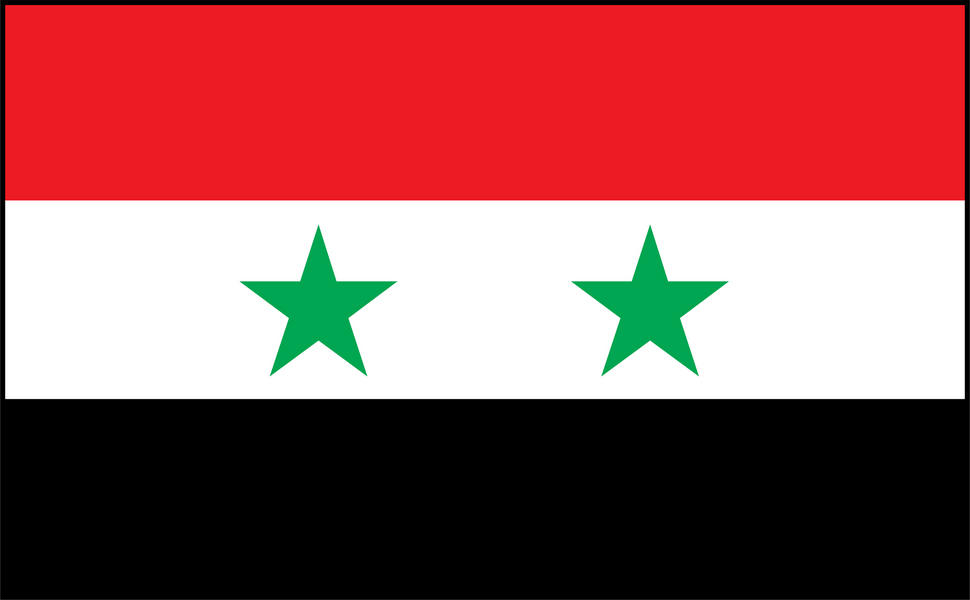
Three horizontal bands of red, white and black with two green five-pointed stars side by side in the white band. These are the pan-Arab colours.
The design dates from 1958, when Syria and Egypt briefly joined as the United Arab Republic, and the two stars stood for the two members. Syria readopted it in 1980. Several flags have been used during the recent conflict by different sides.