
South Korea
South Korea went from one of the poorest countries in the world in 1960 to one of the richest in a single lifetime.
- CapitalSeoulNearly half the country lives in its wider region
- PopulationAbout 52 millionOn the southern half of a peninsula
- Area100,363 km2Around 70 per cent mountainous
- InternetAmong the fastest on EarthAnd near-universal broadband
South Korea occupies the southern half of the Korean Peninsula. The north of the country is mountainous, the west and south have the plains and the cities, and around 3,000 islands lie off the coast.
The Korean War ended in 1953 with an armistice rather than a peace treaty, so North and South are technically still at war. The Demilitarised Zone between them is 250 km long and 4 km wide, and because almost nobody has entered it for 70 years it has become an accidental wildlife sanctuary.
National symbols
- National animal Siberian tiger
- National flower Hibiscus syriacus, the rose of Sharon
- National anthem Aegukga (Translation: Patriotic Song)
- National day National Foundation Day, 3 October
Map of South Korea
Geography
South Korea covers 100,363 km2 and shares one land border, the heavily fortified line with North Korea. The Yellow Sea lies to the west and the Sea of Japan to the east.
Around 70 per cent of the country is mountainous, with the Taebaek range running down the eastern side. The highest point is Hallasan, an extinct volcano on Jeju Island, at 1,947 m. Around 3,000 islands lie off the western and southern coasts.
Climate
South Korea has four sharply defined seasons: cold dry winters, warm springs, hot humid summers and clear crisp autumns.
The summer monsoon, called jangma, brings heavy rain in late June and July, and typhoons can arrive between July and September. Winters are cold, with Seoul often below freezing, because of dry winds blowing off Siberia.
Culture
Korean is the official language, written in Hangul. Confucian ideas about respect for elders and education still shape social behaviour, and school competition is intense.
Korean popular culture has spread worldwide since the 2000s, a wave known as Hallyu: K-pop, Korean films and television dramas. Kimchi, fermented spiced cabbage, is eaten at nearly every meal and its making is on the UNESCO heritage list. Around 56 per cent of South Koreans report no religion.
Economy
South Korea is a technology and manufacturing powerhouse. Samsung and SK Hynix together produce a large share of the world's memory chips, and Samsung is one of the biggest phone makers anywhere.
Hyundai and Kia are major carmakers, and Korean shipyards build a significant proportion of the world's large ships. Korea spends among the highest shares of its economy on research and development of any country.
The flag
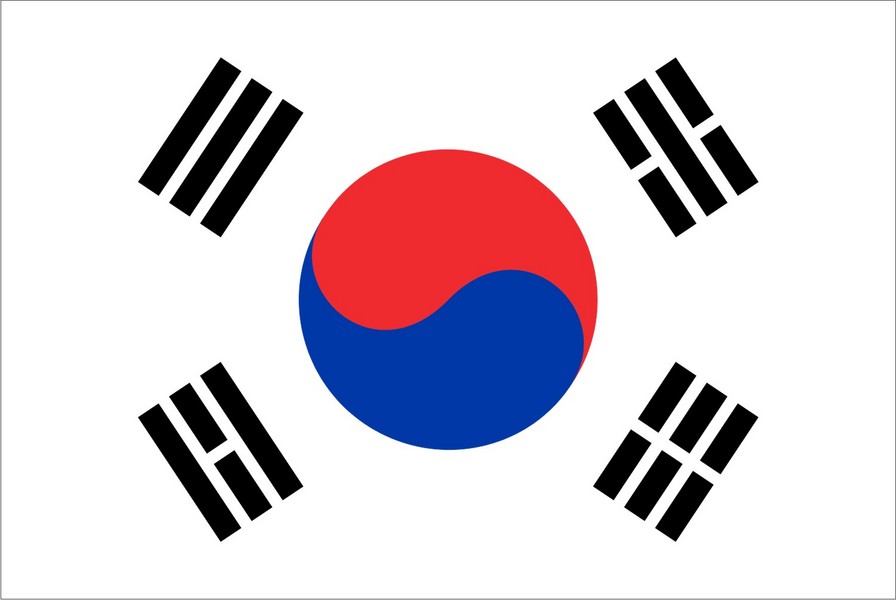
A white field with a circle in the centre divided into a red upper half and a blue lower half, curving around each other. This is the taegeuk, representing balance between opposites.
Around it sit four sets of black bars called trigrams, taken from an ancient Chinese book of divination. They stand for heaven, earth, fire and water, and also for the four seasons and the four directions. White is the traditional Korean colour for peace and purity.