
Singapore
Singapore is a city, an island and a country all at once, and it has grown around 25 per cent bigger by adding land to its own coastline.
- CapitalSingaporeThe city and the country are the same
- PopulationAbout 5.9 millionOne of the densest countries on Earth
- Area735 km2Around a quarter of it reclaimed land
- PortOne of the busiest in the worldA hub for global shipping
Singapore is a small island at the tip of the Malay Peninsula, sitting beside the Strait of Malacca, one of the most important shipping routes on the planet. That position made it a trading port, and trade made it wealthy.
With almost no natural resources and very little land, Singapore has kept expanding by land reclamation, adding around 25 per cent to its original area since the 1960s using sand and rock. It also recycles wastewater into drinking water, branded NEWater, because it has no rivers big enough to supply the population.
National symbols
- National animal Merlion, a mythical lion with a fish tail
- National flower Vanda Miss Joaquim orchid
- National anthem Majulah Singapura (Translation: Onward Singapore)
- National day National Day, 9 August
Map of Singapore
Geography
Singapore covers 735 km2 and has no land borders, though bridges connect it to Malaysia. It sits just north of the equator at the southern tip of the Malay Peninsula.
The main island is low and gently rolling, with the highest point, Bukit Timah, only 164 m. Around 60 smaller islands belong to the country. Roughly a quarter of the current land area has been reclaimed from the sea since independence.
Climate
Singapore is equatorial: hot and humid all year, generally 25C to 32C, with almost no variation between months because it sits practically on the equator.
Rain falls throughout the year, around 2,300 mm annually, with the wettest period from November to January. Sudden heavy afternoon thunderstorms are a daily feature, and Singapore records lightning strikes among the most frequently of anywhere.
Culture
Singapore has four official languages: English, Malay, Mandarin and Tamil. English is the language of government and school, and Malay is the national language used in the anthem.
The population is around 74 per cent Chinese, 14 per cent Malay and 9 per cent Indian, and religious diversity is high: Buddhist, Christian, Muslim, Taoist and Hindu communities all have public holidays. Hawker centres, open-air food courts, are on the UNESCO heritage list.
Economy
Singapore is one of the wealthiest countries in the world per person. Its port is one of the busiest anywhere and a major transshipment hub for global container traffic.
Finance, oil refining, electronics and biomedical manufacturing are the other pillars, along with Changi Airport, consistently rated among the best in the world and a major regional hub.
The flag
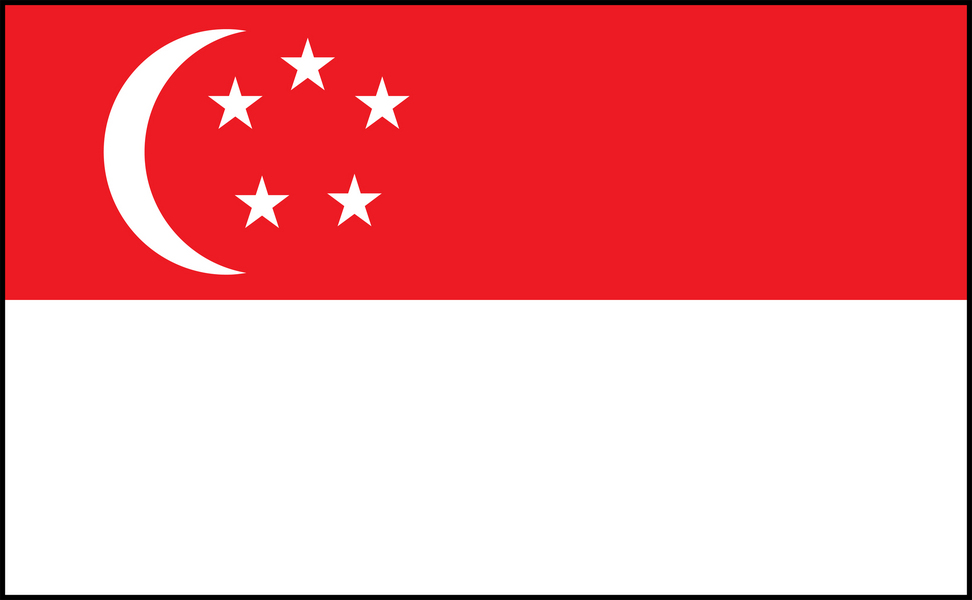
A red band above a white band, with a white crescent moon and five white stars arranged in a circle in the upper left corner.
Red stands for universal brotherhood and equality, and white for purity. The crescent represents a young nation on the rise, and the five stars stand for the country's ideals: democracy, peace, progress, justice and equality.