
Saudi Arabia
Saudi Arabia has no permanent rivers or lakes at all, and it contains the largest continuous sand desert in the world.
- CapitalRiyadhIn the middle of the desert plateau
- PopulationAbout 37 millionMostly in a few large cities
- Area2,149,690 km2Most of the Arabian Peninsula
- RiversNoneNo permanent rivers or lakes anywhere
Saudi Arabia occupies most of the Arabian Peninsula and is almost entirely desert. The Rub al Khali, or Empty Quarter, in the south is the largest continuous sand desert on Earth, covering around 650,000 km2 with dunes up to 250 m high.
The cities of Mecca and Medina are the two holiest places in Islam. Every year several million Muslims travel to Mecca for the Hajj pilgrimage, one of the largest gatherings of people anywhere in the world.
National symbols
- National animal Arabian camel, and the Arabian oryx
- National plant Date palm
- National anthem Aash Al Maleek (Translation: Long Live the King)
- National day Saudi National Day, 23 September
Map of Saudi Arabia
Geography
Saudi Arabia covers 2,149,690 km2 and borders Jordan, Iraq, Kuwait, Qatar, the United Arab Emirates, Oman and Yemen, with the Red Sea to the west and the Persian Gulf to the east.
Mountains run down the western edge parallel to the Red Sea, rising to Jabal Sawda at around 3,000 m. East of them lies a vast desert plateau, and in the south the Rub al Khali, the largest sand sea in the world.
Climate
Saudi Arabia has a harsh desert climate. Summer temperatures regularly exceed 45C and have passed 50C, and the interior is extremely dry.
Nights in the desert can be surprisingly cold because dry air holds no heat, and winter nights in the north sometimes drop below freezing. Rainfall is minimal, under 100 mm a year in most places, though the south-western highlands are wetter and greener.
Culture
Arabic is the official language. Saudi Arabia is the birthplace of Islam, and Islamic law and custom shape daily life, though many social rules have been relaxed since 2017.
Nearly all Saudi citizens are Muslim. Falconry, camel racing and Arabic poetry are strong traditions. The ardah, a sword dance performed with drums and chanted poetry, is on the UNESCO heritage list.
Economy
Oil dominates. Saudi Arabia holds some of the largest proven oil reserves in the world and is one of the biggest exporters, and Saudi Aramco is among the most valuable companies on Earth.
The government's Vision 2030 plan aims to reduce that dependence by building up tourism, entertainment and technology, including enormous construction projects such as the planned linear city NEOM.
The flag
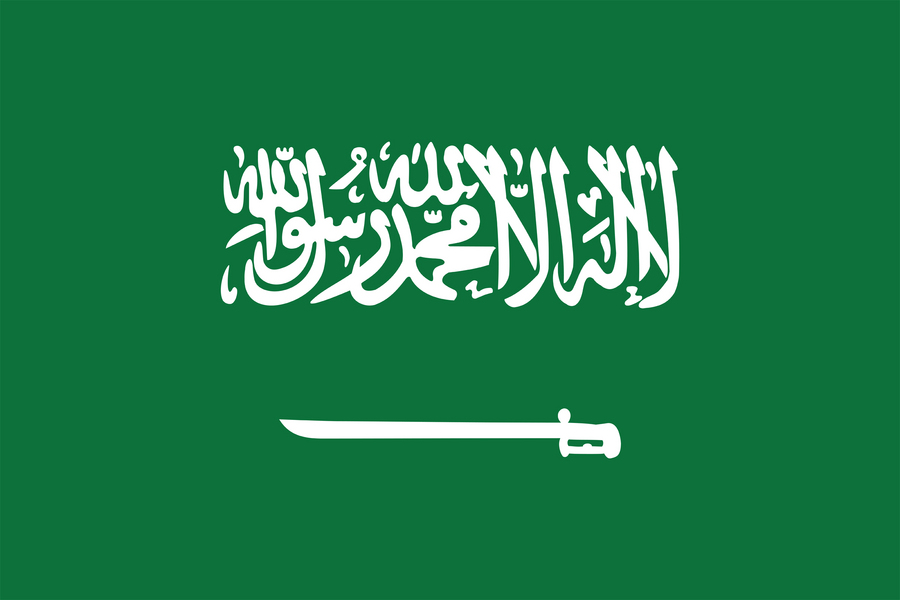
A green field carrying white Arabic script above a white horizontal sword. Green is the traditional colour of Islam.
The script is the shahada, the Islamic declaration of faith. Because it is sacred text, the flag is never flown at half mast and is printed on both sides so the words read correctly from either direction. It is one of only a few national flags with writing as its central feature.