
Pakistan
Pakistan has five of the world's 14 mountains over 8,000 m, including K2, which climbers consider harder than Everest.
- CapitalIslamabadPurpose-built in the 1960s
- PopulationAbout 240 millionFifth most populous country
- Area881,913 km2From Arabian Sea to Himalaya
- K28,611 mThe second highest mountain on Earth
Pakistan runs from the Arabian Sea in the south to some of the highest mountains on the planet in the north. Three great ranges meet there: the Himalaya, the Karakoram and the Hindu Kush. K2, in the Karakoram, is the second highest mountain in the world and far deadlier to climb than Everest.
The Indus River is the country's lifeline, flowing 3,180 km from Tibet to the sea. Along it, around 4,500 years ago, grew the Indus Valley Civilisation, with cities like Mohenjo-daro that had grid-planned streets and covered drains long before most of the world.
National symbols
- National animal Markhor, a wild goat with corkscrew horns
- National bird Chukar partridge
- National anthem Qaumi Taranah (Translation: National Anthem)
- National day Independence Day, 14 August
Map of Pakistan
Geography
Pakistan covers 881,913 km2 and borders India, Afghanistan, Iran and China, with the Arabian Sea to the south.
The north holds five peaks above 8,000 m including K2 at 8,611 m, plus some of the largest glaciers outside the polar regions. The Indus plain runs down the centre and is intensively farmed. The Thar Desert lies in the south-east and the dry Balochistan plateau in the west.
Climate
Most of Pakistan is arid or semi-arid. Summers on the Indus plain are extremely hot, regularly above 45C, and Jacobabad is one of the hottest inhabited places on Earth.
The monsoon brings rain from July to September, and it can cause catastrophic flooding: the 2022 floods put around a third of the country under water. The northern mountains are cold with heavy snow.
Culture
Urdu is the national language and English is used in government and higher education. Punjabi has the most native speakers, along with Sindhi, Pashto and Balochi.
Around 96 per cent of Pakistanis are Muslim. Truck art, where lorries and buses are covered in dazzling hand-painted patterns, poetry and calligraphy, is a distinctive national art form. Cricket is by far the most popular sport.
Economy
Textiles are the backbone: Pakistan is one of the world's largest cotton producers and a major exporter of cloth, bedlinen and clothing.
Agriculture employs a large share of the workforce, growing wheat, rice, sugar cane and mangoes. Money sent home by Pakistanis working abroad, especially in the Gulf, is a major source of foreign income.
The flag
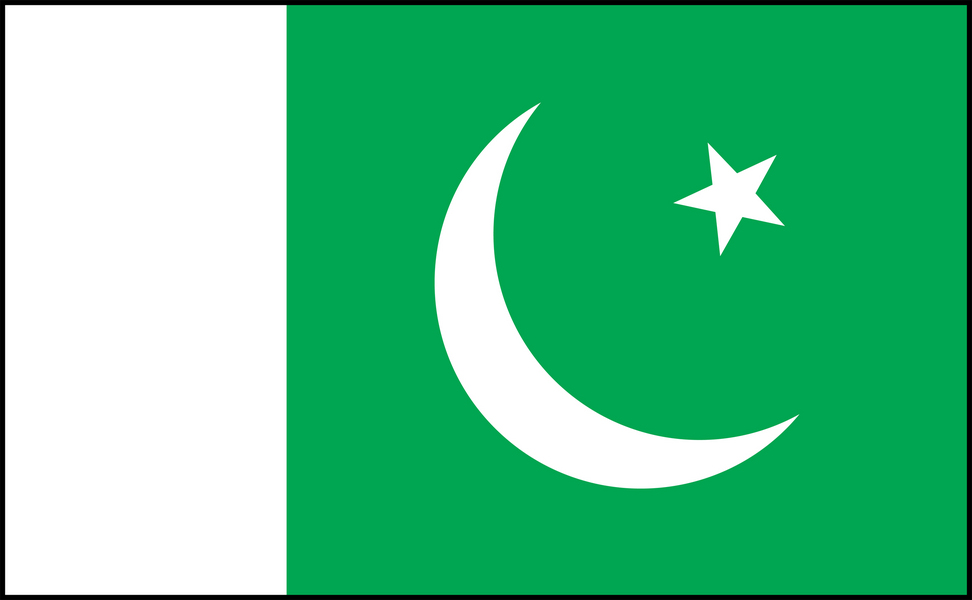
A dark green field with a white crescent moon and five-pointed star in the middle, and a vertical white stripe along the flagpole edge.
Green and the crescent and star represent Islam and the Muslim majority. The white stripe stands for the country's religious minorities, deliberately included in the design. The crescent stands for progress and the star for light and knowledge.