
Oman
Oman has wadis, deep rocky valleys, where fresh water pools between cliffs in the middle of the desert all year round.
- CapitalMuscatSqueezed between mountains and the sea
- PopulationAbout 5.2 millionOn the eastern Arabian Peninsula
- Area309,500 km2Desert, mountains and long coastline
- FrankincenseA historic exportTraded from Oman for thousands of years
Oman occupies the eastern corner of the Arabian Peninsula, with the Hajar Mountains in the north, a long Arabian Sea coastline and desert in between, including part of the Rub al Khali.
For thousands of years Oman traded frankincense, the aromatic resin tapped from Boswellia trees that grow in the southern Dhofar region. It was as valuable as gold in the ancient world and the routes that carried it are a UNESCO World Heritage Site.
National symbols
- National animal Arabian oryx
- National emblem Khanjar dagger crossed with two swords
- National anthem Nashid as-Salaam as-Sultani (Translation: Sultan's Anthem)
- National day National Day, 18 November
Map of Oman
Geography
Oman covers 309,500 km2 and borders the United Arab Emirates, Saudi Arabia and Yemen, with the Gulf of Oman and Arabian Sea along its coast. The Musandam Peninsula, guarding the Strait of Hormuz, is separated from the rest of the country by UAE territory.
The Hajar Mountains run along the north, rising to Jebel Shams at around 3,000 m, with a gorge sometimes called the Grand Canyon of Arabia. Much of the interior is gravel desert and sand, including part of the Rub al Khali.
Climate
Oman has a hot desert climate. Summer temperatures on the coast regularly exceed 40C with high humidity, and the interior is hotter but drier.
The mountains are noticeably cooler, and Jebel Akhdar is high enough to grow roses, pomegranates and apricots. Dhofar in the far south gets the khareef monsoon mist from June to September, which no other part of Arabia receives.
Culture
Arabic is the official language, and Swahili, Baluchi and several South Arabian languages are spoken by different communities.
Nearly all Omanis are Muslim, mostly following the Ibadi school, which is distinct from both Sunni and Shia Islam and is found almost nowhere else. Omani men traditionally wear a dishdasha robe with a khanjar dagger and either a turban or an embroidered cap.
Economy
Oil and natural gas provide most government revenue, though Oman's reserves are smaller than those of its Gulf neighbours.
The country has invested in tourism, logistics and fisheries to diversify. Duqm and Salalah are being developed as major ports, and Oman is exploring green hydrogen production using its abundant sunshine.
The flag
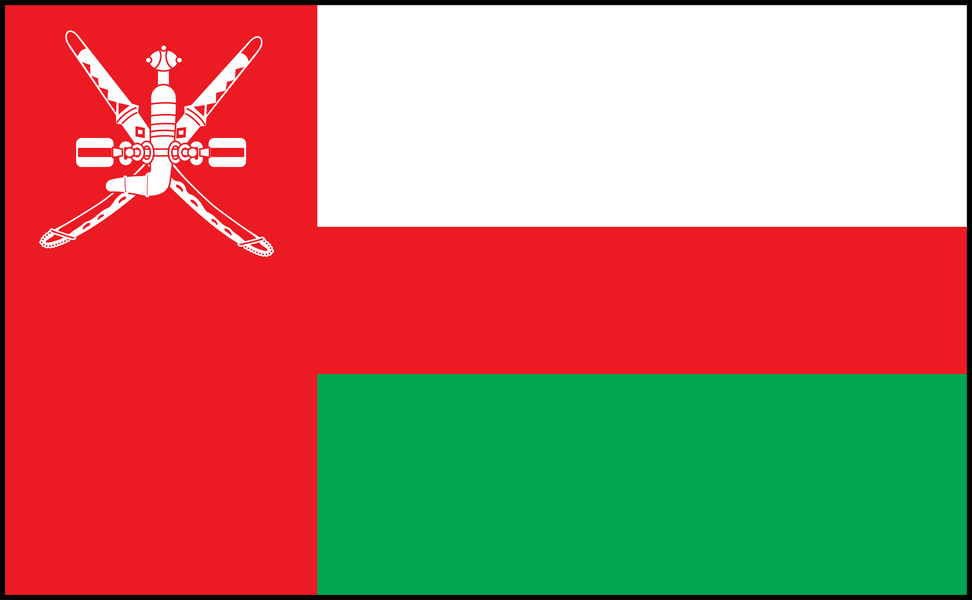
A white band, a red band and a green band running horizontally, with a broad red vertical band along the flagpole edge carrying the national emblem in white.
The emblem shows a khanjar, the curved Omani dagger, crossed with two swords and joined by an ornate belt. White stands for peace and prosperity, red for battles fought against invaders, and green for fertility and the Jebel Akhdar, the Green Mountain.