
North Korea
North Korea is the most closed-off country in the world, and it uses its own calendar counting years from the birth of its founding leader.
- CapitalPyongyangThe only city most visitors ever see
- PopulationAbout 26 millionOn the northern half of the peninsula
- Area120,540 km2Around 80 per cent mountainous
- CalendarJuche eraYear 1 is 1912, Kim Il-sung's birth
North Korea occupies the northern half of the Korean Peninsula. It is mountainous and heavily forested, with the highest peak on the peninsula, Paektu, an active volcano on the Chinese border that holds a crater lake.
Since 1948 the country has been ruled by three generations of the same family. It follows a state ideology called Juche, meaning self-reliance, and access for foreigners, foreign media and the internet is tightly restricted, which is why so little reliable information leaves the country.
National symbols
- National animal Chollima, a mythical winged horse
- National flower Magnolia
- National anthem Aegukka (Translation: Patriotic Song)
- National day Day of the Foundation of the Republic, 9 September
Map of North Korea
Geography
North Korea covers 120,540 km2 and borders China, Russia and South Korea, with the Yellow Sea to the west and the Sea of Japan to the east.
Around 80 per cent of the country is mountains and uplands, which leaves relatively little farmland. Mount Paektu on the Chinese border is the highest point on the peninsula at 2,744 m, an active volcano with a large crater lake called Heaven Lake.
Climate
North Korea has a continental climate with long cold dry winters and short hot humid summers. Winters are colder than in the south because of winds from Siberia.
Most rain falls in a short summer monsoon between June and September, and it often arrives all at once, causing floods. Droughts in other years have contributed to serious food shortages.
Culture
Korean is the official language, written in Hangul, though the northern dialect and vocabulary have drifted from the southern version over 70 years of separation.
Public life centres on the state and on the ruling family, whose portraits hang in homes and public buildings. The Mass Games are enormous synchronised gymnastics and card-flipping displays involving tens of thousands of performers.
Economy
The economy is centrally planned and heavily sanctioned by other countries because of its nuclear weapons programme, which makes reliable figures hard to obtain.
Mining is significant: North Korea has coal, iron ore, magnesite and rare earth deposits. China is by far its largest trading partner. Food production is chronically short of what the population needs.
The flag
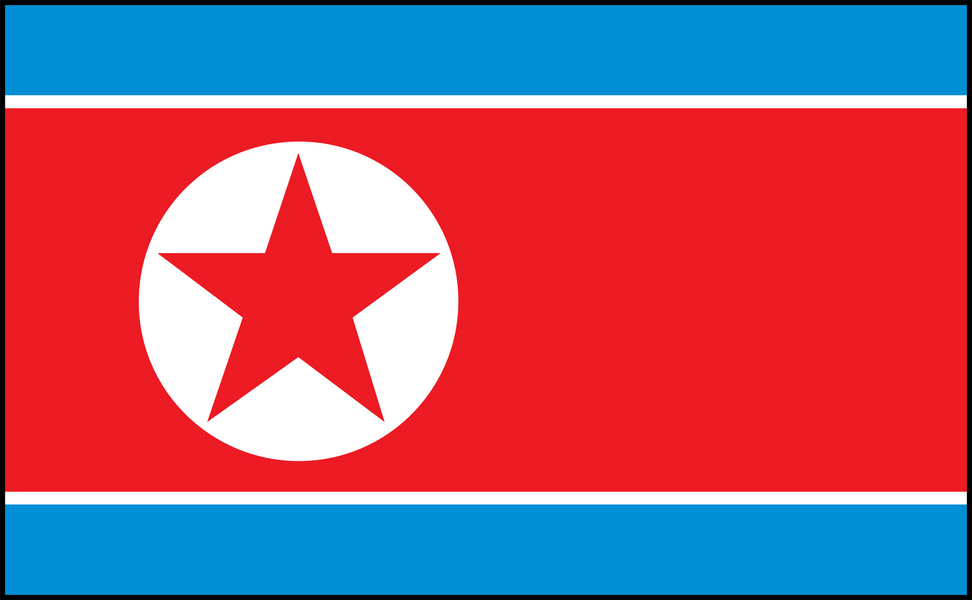
A wide red band across the middle, edged with thin white lines, with blue bands above and below. Towards the flagpole sits a red five-pointed star inside a white circle.
Red stands for revolution and the blood of patriots, blue for peace and for a wish to work with other nations, and white for purity and the unity of the Korean people. The red star is the symbol of communism.