
Nepal
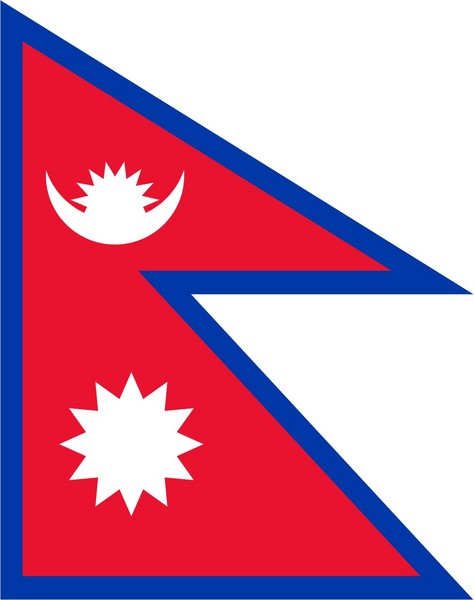
Nepal has the only national flag in the world that is not a rectangle, and it holds eight of the ten highest mountains on Earth.
- CapitalKathmanduIn a bowl-shaped valley in the hills
- PopulationAbout 30 millionBetween India and Tibet
- Area147,516 km2From lowland jungle to 8,849 m
- 8,000 m peaks8 of the world's 14Including Everest
Nepal is a rectangle of land wedged between India and China, and it rises from around 60 m above sea level in the southern Terai plain to 8,849 m at the summit of Everest, all within about 200 km. No other country changes altitude so dramatically over such a short distance.
That means Nepal contains tropical jungle with rhinos and tigers, temperate hill farming, and permanent ice, one after another. Eight of the world's fourteen mountains over 8,000 m are here.
National symbols
- National animal Cow
- National bird Himalayan monal, a brilliantly iridescent pheasant
- National anthem Sayaun Thunga Phulka (Translation: Made of Hundreds of Flowers)
- National day Republic Day, 29 May
Map of Nepal
Geography
Nepal covers 147,516 km2 and borders only China and India. It is landlocked.
The country divides into three strips running east to west: the flat, hot Terai plain in the south, the hill region containing the Kathmandu Valley, and the high Himalaya in the north. Mount Everest, called Sagarmatha in Nepali, stands at 8,849 m on the Chinese border.
Climate
Nepal's climate depends almost entirely on altitude. The Terai is subtropical and hot, the hills are temperate, and the high Himalaya is arctic with permanent snow.
The monsoon arrives in June and lasts until September, bringing most of the annual rain and often triggering landslides in the steep hills. October and November are clear and dry, which is why they are the main trekking season.
Culture
Nepali is the official language, and around 120 other languages are spoken. Nepal is the birthplace of Siddhartha Gautama, the Buddha, born at Lumbini in the Terai around 2,500 years ago.
Around 81 per cent of Nepalis are Hindu and around 9 per cent Buddhist, and the two traditions blend closely, with shared temples and festivals. Nepal uses its own calendar, in which the year is roughly 57 ahead of the Western one.
Economy
Agriculture employs most Nepalis, growing rice, maize, wheat and lentils on terraced hillsides.
Tourism and mountaineering are major earners, with trekking in the Everest and Annapurna regions drawing visitors worldwide. Money sent home by Nepalis working abroad, mainly in the Gulf and Malaysia, is worth around a quarter of the entire economy.
The flag
Two stacked crimson pennants with blue borders, forming a shape unlike any other national flag. The crimson is the colour of the rhododendron, the national flower, and blue stands for peace.
The upper pennant carries a white moon and the lower a white sun. They stand for the hope that Nepal will last as long as the sun and moon, and the two pennants originally represented two branches of the ruling family before being joined in 1962.