
Myanmar
Myanmar has a plain covered with more than 2,000 ancient brick temples, built in a couple of centuries and still standing today.
- CapitalNaypyidawPurpose-built and almost empty
- PopulationAbout 55 millionBetween India, China and Thailand
- Area676,578 km2The largest country in mainland Southeast Asia
- Bagan templesOver 2,000 survivingBuilt between 1050 and 1300
Myanmar, formerly Burma, is the largest country in mainland Southeast Asia. Mountains ring it on three sides and the Irrawaddy River runs down the middle to a wide delta on the Andaman Sea. Most people live along that river.
On the plain at Bagan, more than 10,000 Buddhist temples and stupas were built between 1050 and 1300. Over 2,000 still stand, spread across around 100 km2, and at sunrise the brick spires rise out of the mist in every direction.
National symbols
- National animal Green peafowl, with the chinthe lion as a temple guardian
- National flower Padauk
- National anthem Kaba Ma Kyei (Translation: Till the End of the World)
- National day Independence Day, 4 January
Map of Myanmar
Geography
Myanmar covers 676,578 km2 and borders Bangladesh, India, China, Laos and Thailand, with the Bay of Bengal and Andaman Sea to the south and west.
Mountains form a horseshoe around the country, rising to Hkakabo Razi at 5,881 m in the far north, the highest point in Southeast Asia. The Irrawaddy flows around 2,170 km from north to south into a broad delta. The Shan Plateau lies in the east.
Climate
Myanmar has a tropical monsoon climate with three seasons: hot from March to April, rainy from May to October and cool from November to February.
The coast and delta receive very heavy monsoon rain, over 5,000 mm a year in places, while the central dry zone around Bagan and Mandalay gets under 1,000 mm. Cyclones from the Bay of Bengal are a serious hazard.
Culture
Burmese is the official language, written in a rounded script developed because straight lines would split the palm leaves it was originally written on. Over 100 other languages are spoken by ethnic minority groups.
Around 88 per cent of people are Buddhist, and the Shwedagon Pagoda in Yangon, covered in gold and topped with thousands of gems, is the most sacred site in the country. Thanaka, a pale yellow paste made from ground bark, is worn on the face as sun protection and decoration.
Economy
Agriculture employs most of the workforce, especially rice, beans and pulses. Myanmar is one of the world's largest exporters of pulses.
Natural gas, timber including teak, and jade are major exports. Myanmar produces most of the world's jade, though much of that trade is unregulated. Political instability since the 2021 military coup has badly damaged the economy.
The flag
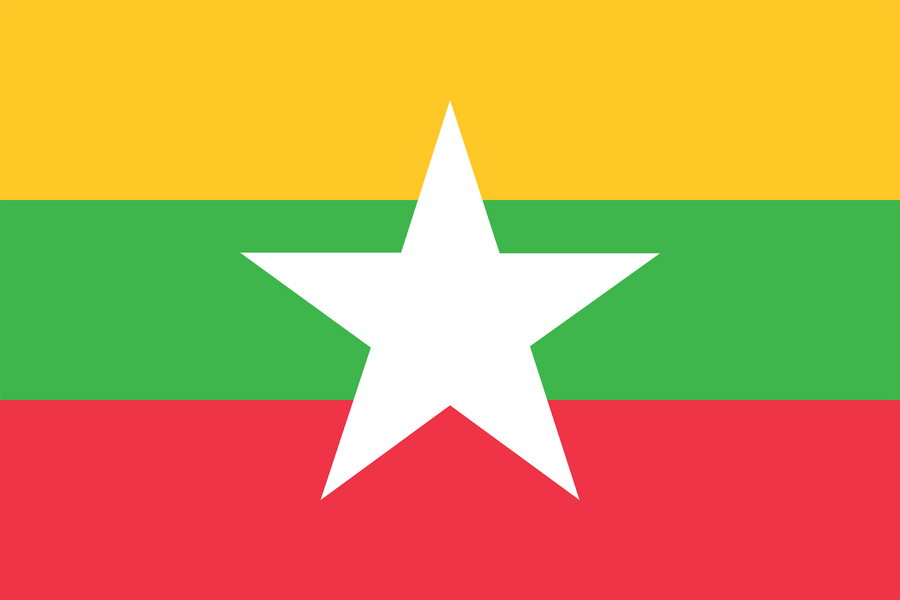
Three horizontal bands of yellow, green and red with a large white five-pointed star overlapping all three in the centre.
Yellow stands for solidarity, green for peace, tranquillity and the country's greenery, and red for courage and determination. The large white star represents the union of the country's many peoples. This design was adopted in 2010, replacing an earlier socialist-era flag.