
Mongolia
Mongolia is the least densely populated country in the world, with around two people for every square kilometre.
- CapitalUlaanbaatarThe coldest capital city in the world
- PopulationAbout 3.5 millionAround half live in the capital
- Area1,564,110 km2Eighteenth largest country
- DensityAbout 2 people per km2The lowest of any country
Mongolia is a vast expanse of steppe grassland, mountains and the Gobi Desert, wedged between Russia and China. It is bigger than Alaska but has fewer people than many single cities, which makes it the emptiest country on Earth.
Around a quarter of Mongolians still live as nomadic or semi-nomadic herders, moving with their horses, sheep, goats, cattle and camels between seasonal pastures and living in round felt tents called gers.
National symbols
- National animal Przewalski's horse, the last truly wild horse
- National bird Saker falcon
- National anthem National Anthem of Mongolia
- National day Naadam Festival, 11 to 13 July
Map of Mongolia
Geography
Mongolia covers 1,564,110 km2 and borders only Russia and China. It is landlocked and one of the highest countries on average, at around 1,580 m above sea level.
The Altai Mountains rise in the west to Khuiten Peak at 4,374 m. Steppe grassland covers much of the centre and north, and the Gobi Desert fills the south. There are almost no forests except in the far north near Siberia.
Climate
Mongolia has an extreme continental climate with enormous swings. Winters are brutally cold, often below minus 30C, and summers can pass 35C.
Ulaanbaatar averages around minus 21C in January, making it the coldest national capital in the world. Rainfall is very low, and a particularly harsh winter after a dry summer, called a dzud, can kill millions of livestock.
Culture
Mongolian is the official language, written in Cyrillic since the 1940s, with the traditional vertical Mongolian script being reintroduced alongside it.
Naadam, held every July, features the three manly games: wrestling, horse racing and archery, with children as young as five riding in cross-country horse races. Khoomei, or throat singing, produces two notes at once and is on the UNESCO heritage list. Around 53 per cent of Mongolians are Buddhist.
Economy
Mining dominates: copper, gold, coal and fluorspar. The Oyu Tolgoi copper and gold mine in the Gobi is one of the largest in the world.
Herding remains central to rural life and Mongolia is a leading producer of cashmere, combed from the undercoat of goats. Its economy rises and falls sharply with global commodity prices.
The flag
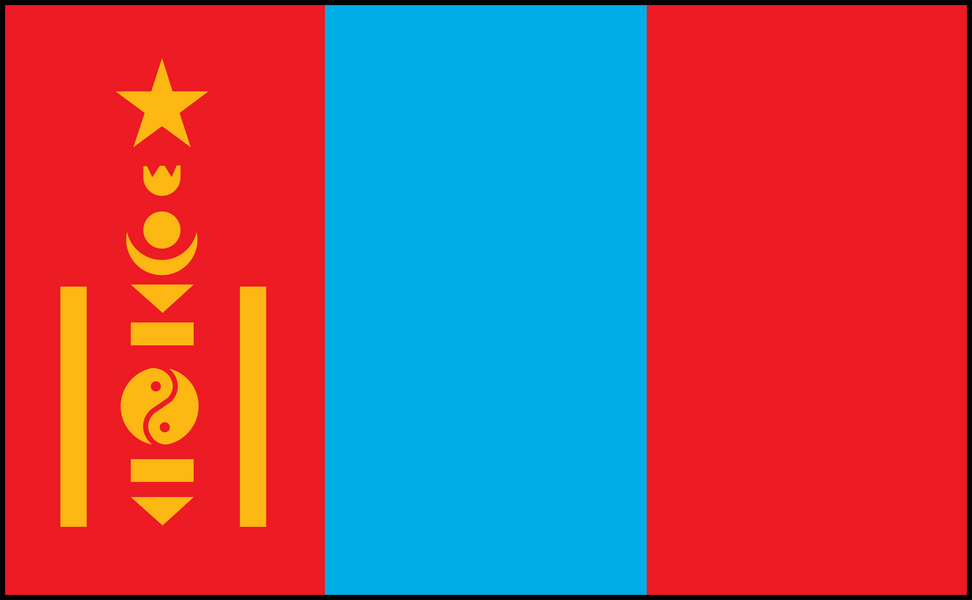
Three vertical bands, red on both sides and blue in the middle. Red stands for progress and prosperity, and blue for the eternal blue sky, a central idea in Mongolian belief.
On the red band nearest the flagpole is the soyombo, a column of symbols including fire, sun, moon, two triangles, two rectangles and two fish. Fire stands for the family line, the fish for watchfulness because fish never close their eyes, and the whole emblem stands for freedom and independence.