
Maldives
The Maldives is the lowest-lying country in the world, with an average height above the sea of only about 1.5 m.
- CapitalMaleOne of the most densely populated islands on Earth
- PopulationAbout 520,000Across around 200 inhabited islands
- IslandsAround 1,190Grouped into 26 atolls
- Average heightAbout 1.5 mThe lowest country in the world
The Maldives is a chain of around 1,190 coral islands in the Indian Ocean, arranged in 26 natural atolls stretching about 870 km from north to south. Only around 200 are inhabited, and another 150 or so hold resorts.
Nowhere in the country rises more than about 2.4 m above sea level, which makes the Maldives the most vulnerable nation on Earth to rising seas. The government has held a cabinet meeting underwater to draw attention to it, and is building an artificial raised island as a possible refuge.
National symbols
- National animal Yellowfin tuna
- National tree Coconut palm
- National anthem Qaumee Salaam (Translation: National Salute)
- National day Independence Day, 26 July
Map of Maldives
Geography
The Maldives covers 298 km2 of land spread across around 90,000 km2 of the Indian Ocean, with no land borders. Sri Lanka and India are the nearest countries.
Every island is a low coral cay sitting on the rim of an atoll, itself built on the top of a submerged volcanic ridge. The highest natural point in the entire country is about 2.4 m, on Villingili, the lowest high point of any nation.
Climate
The Maldives is tropical, hot and humid all year at around 26C to 32C, with very little variation because it sits close to the equator.
Two monsoons shape the year: the wetter south-west monsoon from May to November and the drier north-east monsoon from December to April. The islands lie outside the main cyclone belt, though storms and swells still cause flooding.
Culture
Dhivehi is the official language, written in Thaana, a script that runs right to left and was partly built from Arabic numerals.
Islam is the state religion and all citizens are Muslim. Bodu beru, a style of drumming and dancing with roots in East Africa, is the traditional music. Fishing, especially pole-and-line tuna fishing, has shaped the culture for centuries.
Economy
Tourism dominates, providing a large share of the economy through resorts built on otherwise uninhabited islands.
Fishing is the second industry, and Maldivian tuna is caught by pole and line rather than nets, which avoids catching other species. Almost all food and manufactured goods are imported.
The flag
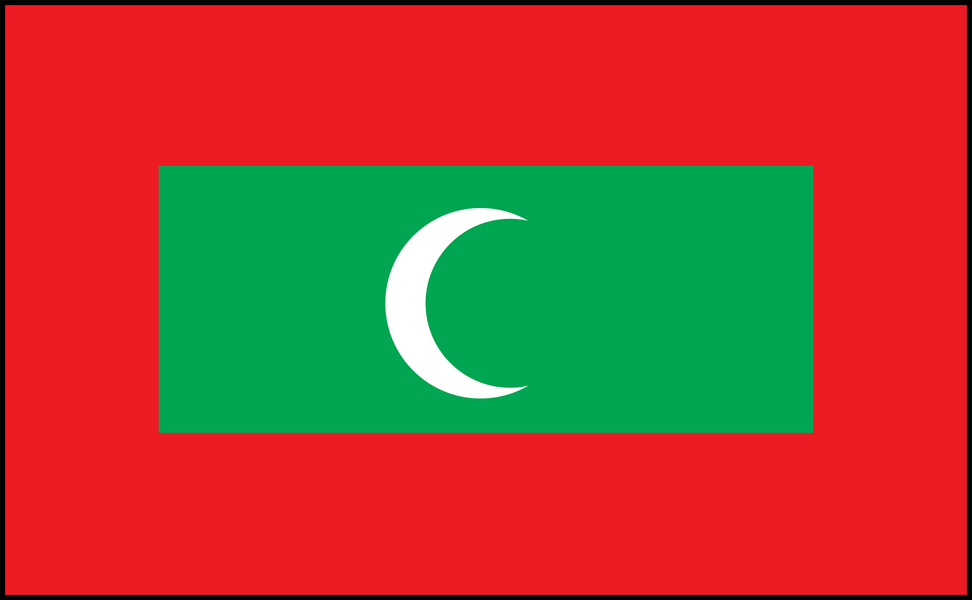
A red field with a large green rectangle in the centre, and inside the green a white crescent moon opening towards the fly.
Red stands for the blood of national heroes and their willingness to defend the country. Green represents the coconut palms, peace and prosperity, and the white crescent stands for Islam, the state religion.