
Malaysia
Malaysia is split in two by 640 km of sea, and its rainforest is around 130 million years old, far older than the Amazon.
- CapitalKuala LumpurGovernment offices sit in nearby Putrajaya
- PopulationAbout 34 millionSplit across two land masses
- Area330,803 km2Peninsular Malaysia plus Borneo states
- Rainforest ageAbout 130 million yearsAmong the oldest on Earth
Malaysia comes in two halves. Peninsular Malaysia hangs off mainland Asia below Thailand, and East Malaysia occupies the northern third of the island of Borneo, around 640 km across the South China Sea.
The Borneo rainforest is one of the oldest on the planet, around 130 million years old, and it survived the ice ages that reshaped forests elsewhere. It is home to orangutans, pygmy elephants and the rafflesia, the largest single flower in the world at up to a metre across.
National symbols
- National animal Malayan tiger
- National flower Bunga raya, the hibiscus
- National anthem Negaraku (Translation: My Country)
- National day Merdeka Day, 31 August
Map of Malaysia
Geography
Malaysia covers 330,803 km2 and borders Thailand, Indonesia and Brunei, with the South China Sea separating its two parts.
A mountainous spine runs down Peninsular Malaysia. In East Malaysia, Mount Kinabalu in Sabah is the highest point at 4,095 m. The Strait of Malacca, between the peninsula and Sumatra, is one of the busiest shipping lanes in the world.
Climate
Malaysia is equatorial: hot, humid and wet all year, typically 25C to 33C with no real seasons, only variations in rainfall.
Two monsoons bring the heaviest rain, the south-west monsoon from May to September and the north-east from November to March. The east coast of the peninsula gets flooding during the north-east monsoon.
Culture
Malay is the official language, and English, Mandarin, Tamil and many Indigenous languages are widely spoken. Malaysia is one of the most multicultural countries in Asia.
Around 64 per cent of Malaysians are Muslim, with substantial Buddhist, Christian and Hindu communities. Because of that mix, the country celebrates Eid, Chinese New Year, Deepavali and Christmas as public holidays. Food is a national obsession, blending Malay, Chinese and Indian traditions.
Economy
Malaysia is a major manufacturer of electronics, especially semiconductors: it handles a significant share of the world's chip packaging and testing.
It is the second largest palm oil producer after Indonesia, which has raised serious questions about rainforest clearance. Oil and gas, rubber and tourism are the other main sectors.
The flag
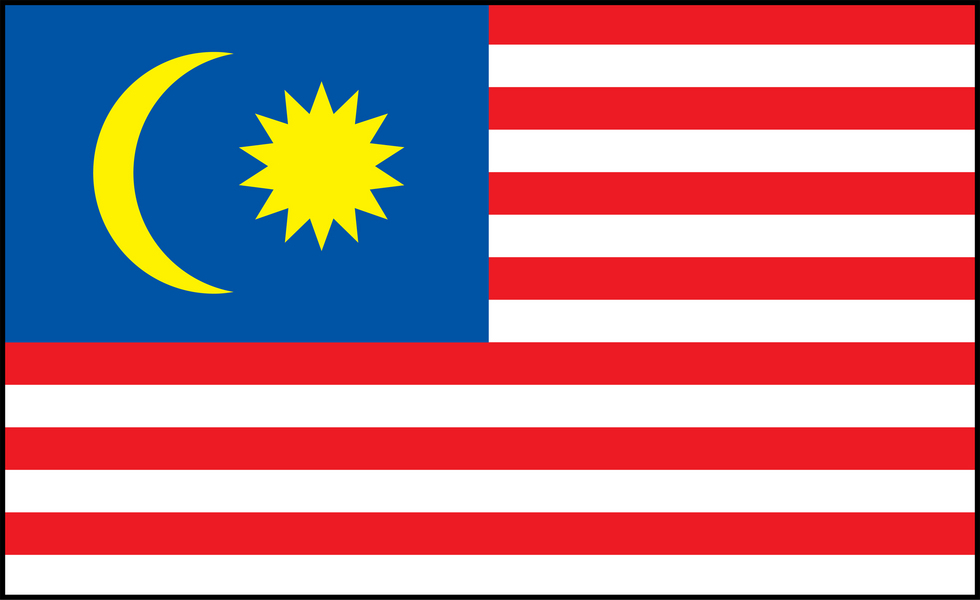
Fourteen alternating red and white stripes with a dark blue rectangle in the upper left containing a yellow crescent and a fourteen-pointed star. It is called the Jalur Gemilang, meaning stripes of glory.
The 14 stripes and 14 star points stand for the 13 states plus the federal government. The crescent represents Islam, the country's official religion, and yellow is the traditional colour of Malay royalty. The blue stands for the unity of the people.