
Laos
Laos is the only landlocked country in Southeast Asia, and it is the most heavily bombed country per person in history.
- CapitalVientianeOn the Mekong, facing Thailand
- PopulationAbout 7.7 millionThe only landlocked country in the region
- Area236,800 km2Around 70 per cent mountains and plateau
- MekongAbout 1,900 km through LaosThe country's main artery
Laos is mountainous, forested and thinly populated, with the Mekong River forming much of its western border and carrying most of its trade and transport. Around 70 per cent of the country is mountain or plateau.
Between 1964 and 1973, during the Vietnam War, around two million tonnes of bombs were dropped on Laos, more than on Germany and Japan combined in the Second World War. Roughly a third failed to explode, and clearance teams are still working through the countryside today.
National symbols
- National animal Asian elephant, once so common the country was called the land of a million elephants
- National flower Dok champa, the frangipani
- National anthem Pheng Xat Lao (Translation: Hymn of the Lao People)
- National day National Day, 2 December
Map of Laos
Geography
Laos covers 236,800 km2 and borders China, Vietnam, Cambodia, Thailand and Myanmar. It is landlocked.
The Annamite range runs along the eastern border with Vietnam, and the highest point is Phou Bia at 2,819 m. The Mekong flows around 1,900 km through or alongside the country, and the lowland plains beside it hold most of the population and rice fields.
Climate
Laos has a tropical monsoon climate with a rainy season from May to October and a dry season from November to April.
The lowlands are hot, often above 33C in the hot months before the rains. The northern mountains are noticeably cooler, and Xiangkhouang on the plateau can drop close to freezing on winter nights.
Culture
Lao is the official language and is closely related to Thai. Around 90 languages are spoken across the country's many ethnic groups.
Around 65 per cent of Laotians are Buddhist. In Luang Prabang, a UNESCO World Heritage town, hundreds of monks in saffron robes walk the streets at dawn collecting alms in silence. Sticky rice is the staple food and is eaten by hand.
Economy
Laos is one of the poorer countries in the region, though it has grown steadily. Hydroelectric power is a flagship export, sold to neighbouring countries.
Mining produces copper and gold, and agriculture, mainly rice, coffee and maize, employs most people. A Chinese-built high-speed railway opened in 2021 linking Vientiane to the Chinese border.
The flag
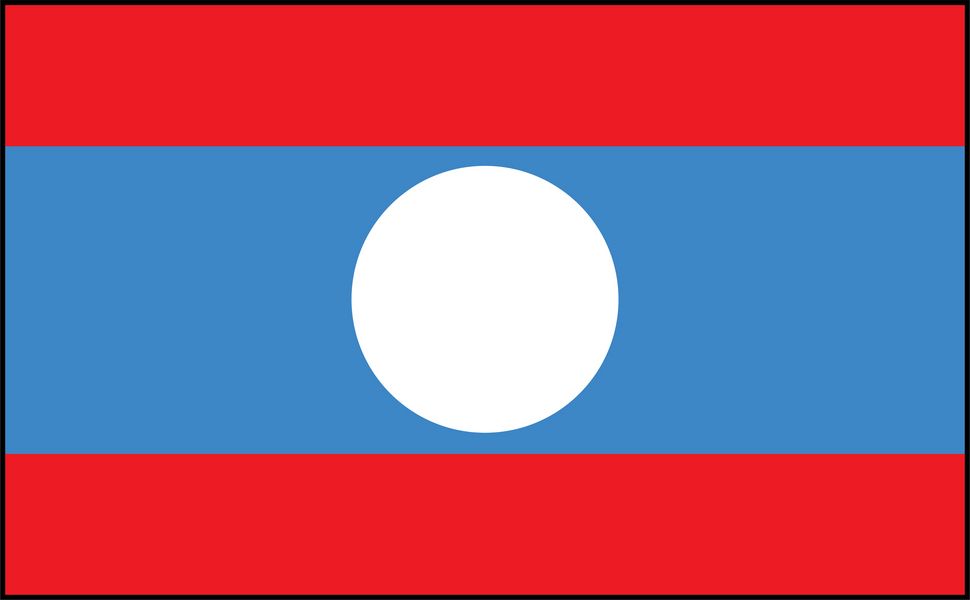
A wide dark blue band across the middle between two red bands, with a large white disc in the centre of the blue.
Red stands for the blood shed in the struggle for independence, blue for the Mekong River and the country's wealth, and the white disc for the full moon over the Mekong and for the unity of the people. Laos is the only communist-governed country whose flag has no star or red banner.