
Kyrgyzstan
Kyrgyzstan is over 90 per cent mountains, and it holds the second largest alpine lake in the world, which never freezes despite the cold.
- CapitalBishkekAt the foot of the Tian Shan mountains
- PopulationAbout 7 millionLandlocked in Central Asia
- Area199,951 km2Over 90 per cent mountainous
- Issyk-KulSecond largest alpine lakeIt never freezes
Kyrgyzstan is dominated by the Tian Shan mountains, which cover over 90 per cent of the country and rise above 7,000 m. Valleys and high pastures between the ranges are where people live and graze animals.
Lake Issyk-Kul sits at around 1,600 m and is the second largest mountain lake in the world after Titicaca. Its name means warm lake: it is slightly salty and fed by hot springs, so it never freezes even when the surrounding air is well below zero.
National symbols
- National animal Snow leopard
- National bird Golden eagle, used in traditional hunting
- National anthem National Anthem of the Kyrgyz Republic
- National day Independence Day, 31 August
Map of Kyrgyzstan
Geography
Kyrgyzstan covers 199,951 km2 and borders Kazakhstan, China, Tajikistan and Uzbekistan. It is landlocked.
The Tian Shan mountains dominate, rising to Jengish Chokusu at 7,439 m on the Chinese border. Lake Issyk-Kul in the north-east covers over 6,000 km2 at an altitude of around 1,600 m. The fertile Fergana Valley reaches into the south-west.
Climate
Kyrgyzstan has a continental climate strongly shaped by altitude. Valleys have hot summers and cold winters, while the high mountains are freezing year-round with permanent glaciers.
Bishkek averages around minus 4C in January and 25C in July. The Issyk-Kul basin is milder than the surrounding land because the lake stores heat, which is why it became a holiday region.
Culture
Kyrgyz is the state language and Russian is an official language, widely used in government and cities. Kyrgyz is a Turkic language.
Around 90 per cent of Kyrgyzstanis are Muslim, mostly Sunni. Yurt-making, felt carpets called shyrdaks, horseback games including kok-boru, and eagle hunting are all living traditions. Kymyz, fermented mare's milk, is the national drink.
Economy
Gold mining is the largest single industry, dominated by the Kumtor mine high in the mountains.
Agriculture and livestock herding employ a large share of the population. Money sent home by Kyrgyzstanis working in Russia and Kazakhstan makes up a very large part of the economy, among the highest shares of any country.
The flag
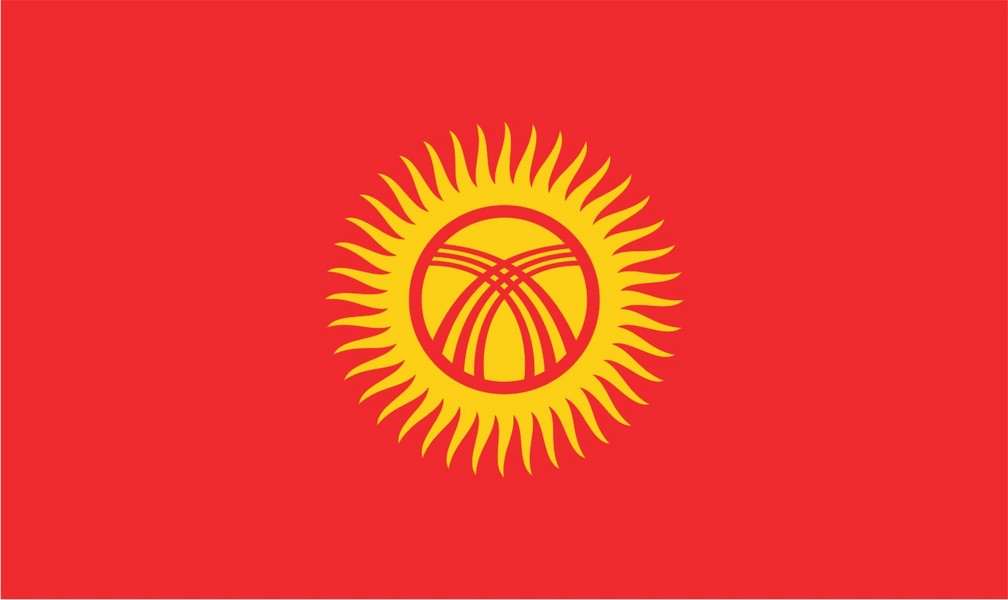
A red field with a yellow sun in the centre, its forty rays standing for the forty Kyrgyz tribes united by the hero Manas.
Inside the sun is a stylised tunduk, the crossed wooden roof-frame at the top of a yurt, seen from below. It stands for home, family and the unity of the nation. Red is said to come from the banner of Manas himself.