
Jordan
Jordan contains Petra, an entire city carved into rose-red sandstone cliffs over 2,000 years ago and then lost to the outside world for centuries.
- CapitalAmmanBuilt across a series of hills
- PopulationAbout 11.5 millionIncluding many refugees
- Area89,342 km2Around 75 per cent desert
- Dead SeaAbout 430 m below sea levelThe lowest land on Earth
Jordan is mostly desert, with a fertile strip along the west where the Jordan River runs down to the Dead Sea. The Rift Valley cuts through the country from north to south and contains the Dead Sea, whose shore is the lowest dry land on the planet.
Petra was carved by the Nabataeans from around 300 BC. They cut temples, tombs and a treasury directly into the cliff faces, and built an ingenious system of channels and cisterns to supply a desert city with water. Europeans rediscovered it in 1812.
National symbols
- National bird Sinai rosefinch
- National flower Black iris
- National anthem As-Salam Al-Malaki Al-Urdoni (Translation: Long Live the King)
- National day Independence Day, 25 May
Map of Jordan
Geography
Jordan covers 89,342 km2 and borders Saudi Arabia, Iraq, Syria, Israel and the Palestinian territories, with a very short coast on the Red Sea at Aqaba.
The Jordan Rift Valley runs down the west, containing the Jordan River and the Dead Sea, whose shore is around 430 m below sea level. Highlands rise beside it, and the eastern three quarters of the country is desert plateau.
Climate
Jordan has a Mediterranean climate in the north-west with mild wet winters and hot dry summers, becoming desert climate further east and south.
Amman can get snow in winter because it sits around 1,000 m up. Water is severely scarce: Jordan is one of the most water-poor countries in the world and depends on careful management and shared river resources.
Culture
Arabic is the official language and English is widely spoken. Around 98 per cent of Jordanians are Arab, with Circassian and Armenian minorities.
Around 95 per cent of the population is Muslim, mainly Sunni, with a long-established Christian minority. Mansaf, lamb cooked in fermented dried yoghurt and served on flatbread and rice, is the national dish and is eaten communally from one large tray.
Economy
Jordan has few natural resources and limited water, so it built a services economy: banking, healthcare and education draw people from across the region.
Phosphates and potash extracted from the Dead Sea are the main mineral exports. Tourism to Petra, Wadi Rum and the Dead Sea is important, and money sent home by Jordanians working in the Gulf is significant.
The flag
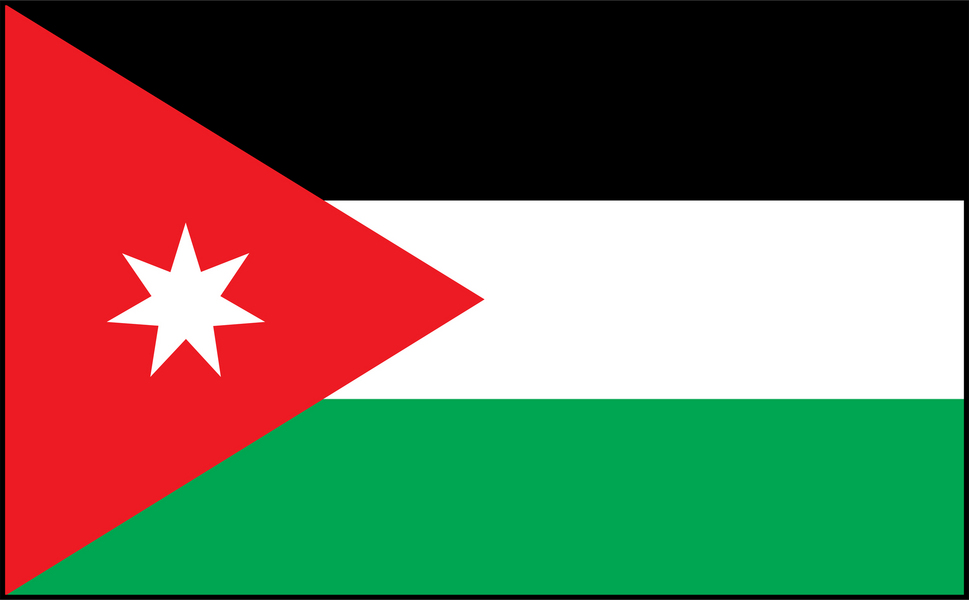
Three horizontal bands of black, white and green with a red triangle at the flagpole edge bearing a small white seven-pointed star.
The three bands stand for three historic Arab dynasties: the Abbasid, Umayyad and Fatimid. The red triangle represents the Hashemite family and the Arab Revolt. The seven points of the star stand for the seven verses of the opening chapter of the Quran.