
Japan
Japan is a chain of over 14,000 islands sitting on top of the Ring of Fire, and it records around 1,500 earthquakes every year.
- CapitalTokyoThe largest metropolitan area in the world
- PopulationAbout 124 millionShrinking and ageing fast
- Area377,975 km2About 73 per cent mountainous
- EarthquakesAround 1,500 a yearMost too small to feel
Japan is an archipelago off the east coast of Asia. Four islands hold nearly everyone: Honshu, the largest, plus Hokkaido, Kyushu and Shikoku, with Okinawa far to the south. Around 73 per cent of the land is mountainous, so the population is squeezed into the coastal plains.
Japan sits where four tectonic plates meet. That gives it around 110 active volcanoes, including Mount Fuji, constant earthquakes and the risk of tsunami. Japanese buildings and trains are engineered for it: skyscrapers sway on purpose, and bullet trains stop automatically when tremors are detected.
National symbols
- National bird Green pheasant
- National flower Cherry blossom, and the chrysanthemum for the imperial family
- National anthem Kimigayo (Translation: His Imperial Majesty's Reign)
- National sport Sumo wrestling
Map of Japan
Geography
Japan covers 377,975 km2 and has no land borders. It stretches about 3,000 km through the Pacific Ocean and the Sea of Japan, off the coasts of Korea, China and Russia.
The four main islands are Honshu, Hokkaido, Kyushu and Shikoku. Mount Fuji, an active volcano, is the highest point at 3,776 m. Because the mountains reach close to the sea, Japanese rivers are short, steep and fast, and there are very few large plains.
Climate
Japan runs from subarctic Hokkaido in the north to subtropical Okinawa in the south, so its climate varies enormously. Most of the country has four distinct seasons.
Summers are hot and humid with a rainy season in June and July. Typhoons hit between August and October. Winters bring extremely heavy snow to the west coast facing the Sea of Japan, where some towns record several metres a year.
Culture
Japanese is the language, written with three scripts used together: kanji characters borrowed from Chinese, plus hiragana and katakana.
Around 70 per cent of Japanese people follow Shinto practices and about 67 per cent Buddhist ones, and most take part in both without conflict. Hanami, picnicking under cherry blossom in spring, is a national tradition. Manga and anime are read and watched worldwide.
Economy
Japan has one of the largest economies in the world, built on high-quality manufacturing: cars from Toyota, Honda and Nissan, plus electronics, robotics and precision machinery.
It leads the world in industrial robots and in many specialised components that other countries' factories depend on. Japan imports most of its energy and much of its food, because so little of the land can be farmed.
The flag
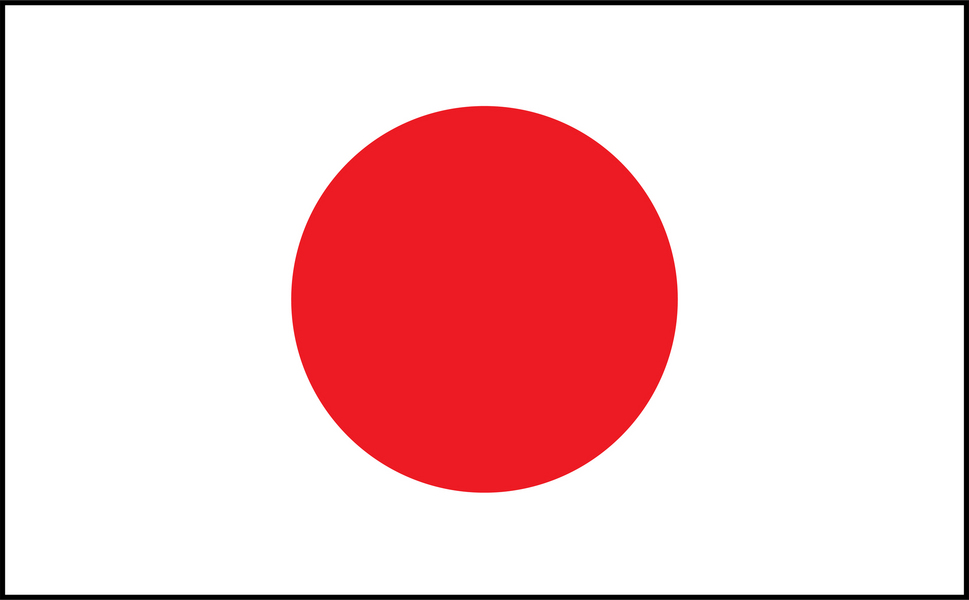
A white field with a large crimson circle slightly left of centre. Japanese people call it Hinomaru, meaning circle of the sun.
The sun matters because Japan's name in Japanese, Nippon, means origin of the sun, which is why it is called the Land of the Rising Sun. From China, Japan lies towards the sunrise. The design has been used for centuries and was made the official flag in 1999.