
Israel
Israel contains the lowest point on any land surface on Earth, the shore of the Dead Sea, around 430 m below sea level.
- CapitalJerusalemIts status is internationally disputed
- PopulationAbout 9.8 millionOn a strip of the eastern Mediterranean
- Area22,072 km2About the size of Wales
- Dead Sea shoreAbout 430 m below sea levelThe lowest land on Earth
Israel is a narrow country on the eastern Mediterranean, running from the Lebanese border in the north to the Red Sea at Eilat. The northern half has hills, farmland and the freshwater Sea of Galilee, while the southern half is the Negev Desert.
The Dead Sea, on the Jordanian border, sits in the deepest land depression on the planet. It is around ten times saltier than the ocean, so nothing lives in it and swimmers float without effort. It is also shrinking by around a metre a year as its water is diverted.
National symbols
- National bird Hoopoe
- National emblem Menorah, a seven-branched lampstand, with olive branches
- National anthem Hatikvah (Translation: The Hope)
- National day Independence Day, in April or May by the Hebrew calendar
Map of Israel
Geography
Israel covers 22,072 km2 and borders Lebanon, Syria, Jordan and Egypt, with the Mediterranean Sea to the west and a short Red Sea coast at Eilat.
A coastal plain runs along the Mediterranean, backed by central highlands. The Jordan Rift Valley cuts down the eastern side and contains the Sea of Galilee and the Dead Sea, whose shore is around 430 m below sea level. The Negev Desert covers the southern half of the country.
Climate
Israel has a Mediterranean climate in the north and centre, with hot dry summers and mild wet winters. Snow occasionally falls in Jerusalem and regularly on Mount Hermon.
The Negev in the south is arid to hyper-arid, with under 100 mm of rain a year in places. Eilat on the Red Sea is one of the driest and sunniest spots, with year-round warmth.
Culture
Hebrew is the official language, and Arabic has special status. Hebrew is the only example of an ancient language that stopped being spoken daily and was successfully revived as a living national language.
Around 74 per cent of Israelis are Jewish and around 21 per cent Arab, mostly Muslim. Jerusalem holds sites sacred to Judaism, Christianity and Islam within a few hundred metres of each other. Shabbat, from Friday evening to Saturday evening, quietens much of the country.
Economy
Israel is known for high technology and is sometimes called Startup Nation, with one of the highest rates of startup companies per person in the world.
Cybersecurity, medical devices, semiconductors and agricultural technology are strengths. Cut diamonds are a traditional export, and desert farming techniques developed here are used worldwide.
The flag
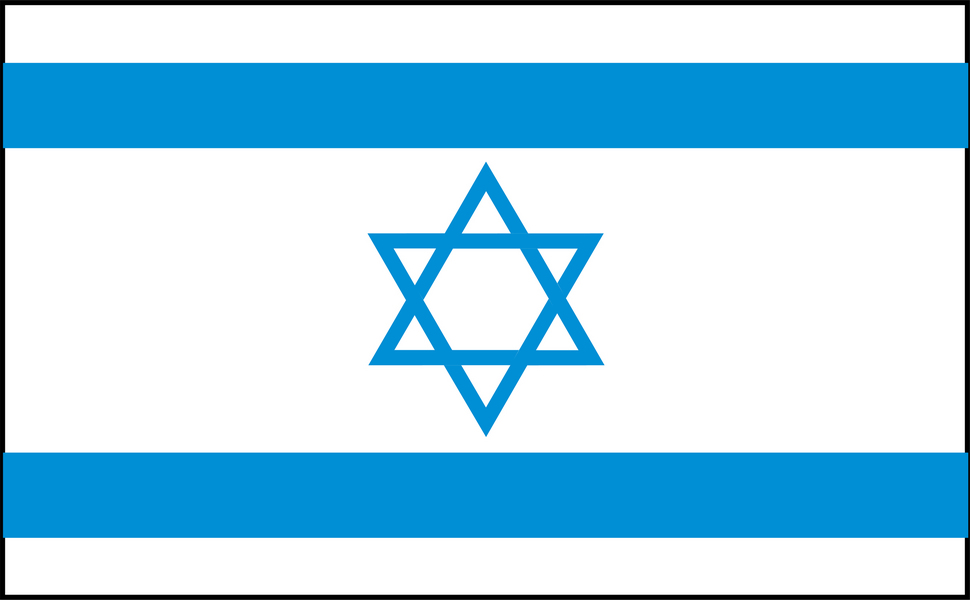
A white field with two horizontal blue stripes near the top and bottom, and a blue six-pointed Star of David in the centre.
The design is based on the tallit, the Jewish prayer shawl, which is white with blue stripes. The Star of David, or Magen David, has been a Jewish symbol for centuries. The flag was adopted in 1948, months after the state was established.