
India
India has more people than any other country, and it recognises 22 official languages plus hundreds more spoken every day.
- CapitalNew DelhiPart of the larger city of Delhi
- PopulationAbout 1.43 billionThe most populous country on Earth
- Area3,287,263 km2Seventh largest country
- Official languages22Plus hundreds of others in daily use
India is a huge triangular peninsula reaching into the Indian Ocean, walled off from the rest of Asia by the Himalayas in the north. Between the mountains and the southern plateau lies the Indo-Gangetic Plain, one of the most fertile and heavily populated regions on Earth.
The Himalayas were pushed up when the Indian plate crashed into Asia around 50 million years ago, and they are still rising by about 5 mm a year. They also create the monsoon, the seasonal rains that the whole country depends on.
National symbols
- National animal Bengal tiger
- National bird Indian peacock
- National anthem Jana Gana Mana
- National day Republic Day, 26 January
Map of India
Geography
India covers 3,287,263 km2 and borders Pakistan, China, Nepal, Bhutan, Bangladesh and Myanmar, with the Arabian Sea, Bay of Bengal and Indian Ocean around its long coastline.
The Himalayas run along the north and hold Kangchenjunga at 8,586 m, the highest point in India. The Ganges flows across the northern plain and is considered sacred by Hindus. The Deccan Plateau fills much of the south, bordered by the Western and Eastern Ghats.
Climate
India is dominated by the monsoon. From June to September, moist air sweeps in from the Indian Ocean and drops most of the year's rain in a few months. Farmers depend on it entirely.
Before the rains, temperatures across the north can pass 45C. The Thar Desert in the west is hot and dry, the north-east is one of the wettest places on Earth, and the Himalayan north stays cold with permanent snow.
Culture
Hindi and English are the official languages of the central government, and 22 languages are recognised in the constitution. Bengali, Telugu, Marathi and Tamil each have tens of millions of speakers.
Around 80 per cent of Indians are Hindu and around 14 per cent Muslim, with Sikh, Christian, Buddhist and Jain communities as well. Diwali, the festival of lights, and Holi, the festival of colours, are celebrated across the country. Indian cinema produces more films a year than any other country.
Economy
India has one of the fastest-growing large economies in the world. Information technology and outsourcing services are a flagship sector, centred on Bengaluru and Hyderabad.
It is the largest producer of milk in the world and a leading grower of rice, wheat, tea, cotton and spices. Pharmaceuticals are another strength: India makes a very large share of the world's generic medicines and vaccines.
The flag
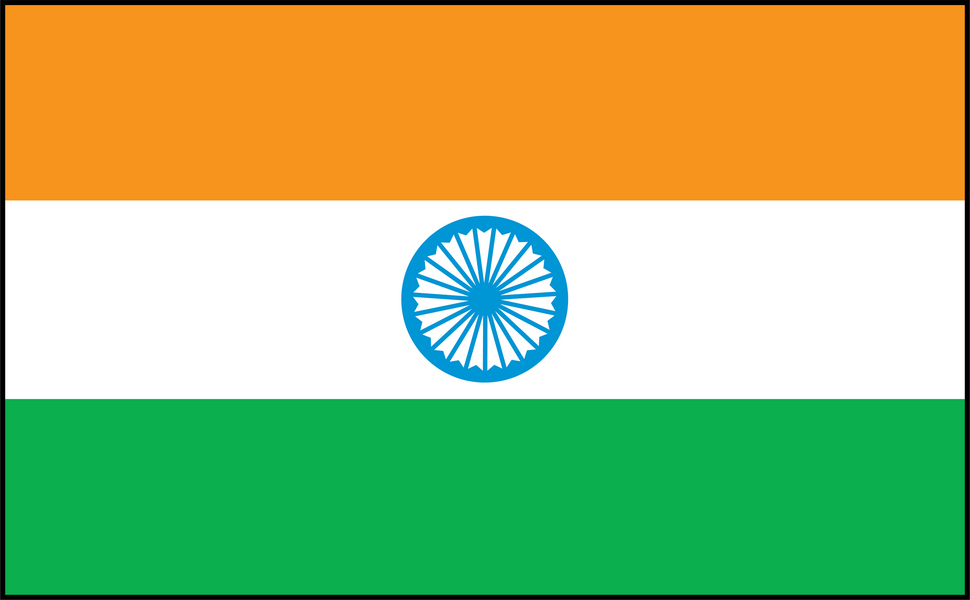
Three horizontal bands: saffron on top, white in the middle and green below, with a navy blue wheel in the centre.
Saffron stands for courage and sacrifice, white for peace and truth, and green for faith and fertility. The wheel is the Ashoka Chakra, a Buddhist symbol from a pillar built by Emperor Ashoka in the 3rd century BC. Its 24 spokes stand for the law and for continual forward motion.