
Cambodia
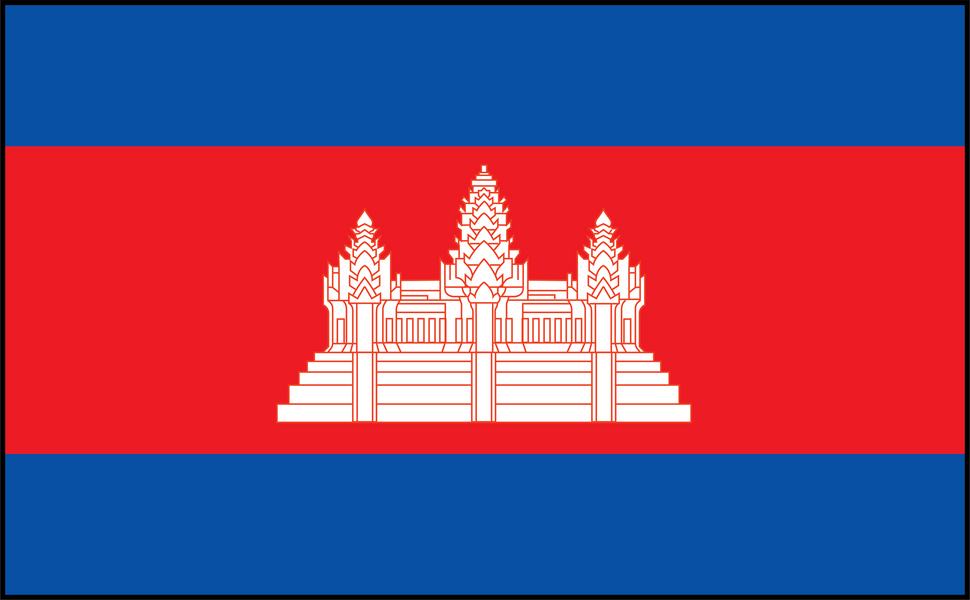
Cambodia is the only country in the world with a building on its flag: Angkor Wat, the largest religious monument ever built.
- CapitalPhnom PenhWhere four river branches meet
- PopulationAbout 17 millionCentred on the Mekong and Tonle Sap
- Area181,035 km2Mostly low central plain
- Angkor WatLargest religious monumentCovering about 162 hectares
Cambodia is a low, flat country built around the Mekong River and the Tonle Sap lake. The lake does something extraordinary: during the monsoon the Mekong rises so much that it forces the Tonle Sap river to flow backwards, and the lake swells to around five times its dry-season size.
Angkor Wat, built in the 12th century, is the largest religious monument in the world. It was the centre of the Khmer Empire, whose capital Angkor may have held around 750,000 people, making it one of the largest cities on Earth at the time.
National symbols
- National animal Kouprey, a wild ox, possibly now extinct
- National flower Rumduol
- National anthem Nokor Reach (Translation: Majestic Kingdom)
- National day Independence Day, 9 November
Map of Cambodia
Geography
Cambodia covers 181,035 km2 and borders Thailand, Laos and Vietnam, with a coast on the Gulf of Thailand.
Most of the country is a low central plain around the Mekong and the Tonle Sap. The Cardamom Mountains rise in the south-west, reaching Phnom Aural at 1,810 m, and the Dangrek escarpment forms part of the Thai border in the north.
Climate
Cambodia has a tropical monsoon climate, hot all year at around 25C to 35C, with a rainy season from May to October and a dry season from November to April.
The rains are what drive the Tonle Sap flood cycle, which supports one of the most productive freshwater fisheries in the world. The hottest months are March and April, before the monsoon breaks.
Culture
Khmer is the official language, written in a script with 74 letters, one of the longest alphabets in the world.
Around 97 per cent of Cambodians are Buddhist. Apsara dance, with slow precise hand movements and elaborate golden headdresses, is depicted on the walls of Angkor and is still performed today. Around 96 per cent of the population is ethnic Khmer.
Economy
Garment and footwear manufacturing is the largest export sector, supplying international brands.
Tourism centred on Angkor is a major earner. Rice is the main crop, and Cambodia has been developing rice exports along with rubber, cassava and fish from the Tonle Sap.
The flag
A wide red band between two blue bands, with a white three-towered outline of Angkor Wat in the centre.
Blue stands for the monarchy, red for the nation and white for religion. Cambodia is the only country whose flag shows a building. The design dates from 1948 and was restored in 1993 after decades of other regimes and other flags.