
Brunei
Brunei is a tiny, oil-rich sultanate on Borneo where around 70 per cent of the land is still covered in rainforest.
- CapitalBandar Seri BegawanIncludes a large village built on stilts
- PopulationAbout 460,000On the island of Borneo
- Area5,765 km2Around 70 per cent rainforest
- RulerSultan since 1967One of the longest-reigning monarchs
Brunei is a small country on the north coast of Borneo, split into two parts by Malaysian territory. It is one of the few places in Southeast Asia where most of the original rainforest survives, because oil wealth meant it never needed to log or clear it for palm oil.
Kampong Ayer, in the capital, is a settlement of houses, mosques, schools and shops built on stilts over the Brunei River. Around 13,000 people live there, and it has been continuously inhabited for over 1,000 years.
National symbols
- National animal Proboscis monkey, found only on Borneo
- National flower Simpor, the simpoh air
- National anthem Allah Peliharakan Sultan (Translation: God Bless the Sultan)
- National day National Day, 23 February
Map of Brunei
Geography
Brunei covers 5,765 km2 on the north coast of Borneo and borders only Malaysia, which surrounds it and splits it into two separate parts. The South China Sea lies to the north.
A narrow coastal plain rises to hills inland, reaching Bukit Pagon at 1,850 m. Around 70 per cent of the country remains under rainforest, and the Ulu Temburong National Park protects a large tract of it, reachable only by longboat.
Climate
Brunei has an equatorial climate: hot, humid and wet all year, typically 24C to 32C with no real seasons.
Rainfall is heavy, around 2,700 mm a year on the coast and considerably more inland, which is what sustains the rainforest. There is no cyclone risk, as Borneo sits outside the typhoon belt.
Culture
Malay is the official language and English is widely used. Chinese and several Indigenous Bornean languages are also spoken.
Around 82 per cent of Bruneians are Muslim, and Islam is the state religion under a philosophy called Melayu Islam Beraja, meaning Malay Islamic Monarchy. The Sultan Omar Ali Saifuddien Mosque, with its gold dome reflected in a lagoon, is the national landmark.
Economy
Oil and natural gas provide the overwhelming majority of government revenue and exports, giving Brunei one of the highest incomes per person in Southeast Asia.
The government has tried to diversify into halal food production, tourism and financial services, but hydrocarbons still dominate. There is no income tax and the state provides extensive free services.
The flag
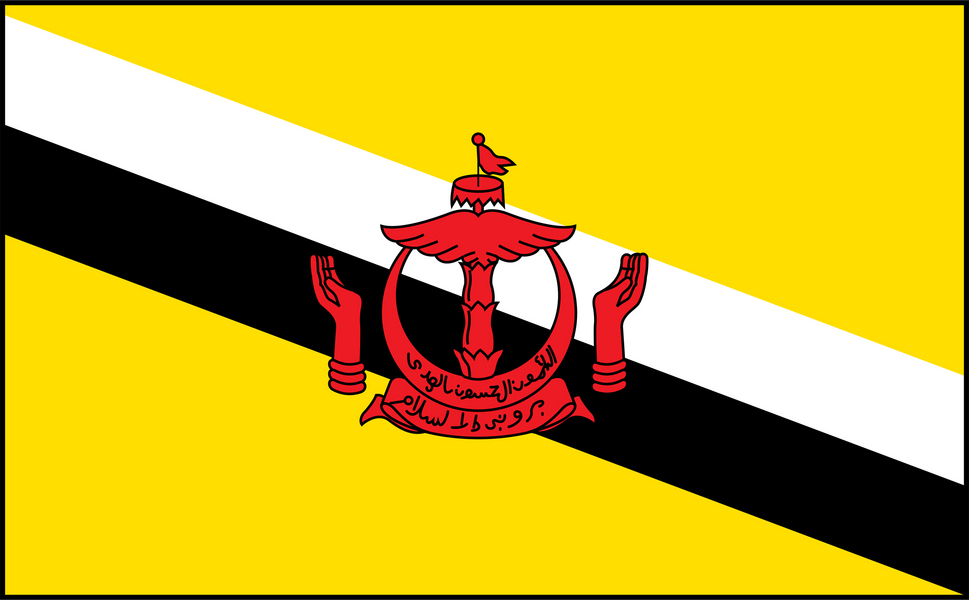
A yellow field crossed diagonally by a white stripe above a black one, with the national crest in red in the centre.
Yellow is the traditional colour of the sultan, and the white and black stripes represent the two chief ministers of the state. The crest includes a crescent for Islam, a parasol for royalty, and upturned hands symbolising the government's pledge to protect and promote the welfare of the people.