
Bhutan
Bhutan measures its success by Gross National Happiness rather than money, and it is the only country in the world that absorbs more carbon than it produces.
- CapitalThimphuThe only capital with no traffic lights
- PopulationAbout 790,000In the eastern Himalayas
- Area38,394 km2Around 70 per cent forest
- CarbonCarbon negativeAbsorbs more CO2 than it emits
Bhutan is a small Himalayan kingdom between India and China, rising from subtropical plains in the south to peaks over 7,000 m in the north. Its constitution requires that at least 60 per cent of the country stay forested forever, and the actual figure is around 70 per cent.
Because of that forest, Bhutan absorbs far more carbon dioxide than the whole country emits, making it the only carbon-negative nation in the world.
National symbols
- National animal Takin, a strange goat-antelope
- National bird Raven, which appears on the royal crown
- National anthem Druk tsendhen (Translation: The Thunder Dragon Kingdom)
- National day National Day, 17 December
Map of Bhutan
Geography
Bhutan covers 38,394 km2 and borders only China and India. It is landlocked.
The land rises steeply from subtropical foothills in the south, through temperate valleys where most people live, to the high Himalaya in the north. Gangkhar Puensum, at 7,570 m, is the highest unclimbed mountain in the world: Bhutan has banned climbing peaks above 6,000 m out of respect for local beliefs.
Climate
Bhutan's climate changes dramatically with altitude. The southern foothills are subtropical and humid, the central valleys are temperate, and the northern mountains have permanent snow and ice.
The monsoon brings heavy rain from June to September, especially in the south. Winters are cold in the valleys and severe at altitude, when many high passes close.
Culture
Dzongkha is the official language, and several other languages are spoken across the valleys. Traditional dress, the gho for men and kira for women, is required in schools and government offices.
Around 75 per cent of Bhutanese are Buddhist. Dzongs, enormous fortress monasteries, serve as both religious and administrative centres in each district. The Tiger's Nest monastery clings to a cliff 900 m above the Paro valley.
Economy
Hydroelectric power is the largest export, sold to India, generated by fast rivers running off the Himalaya.
Tourism is deliberately limited: visitors pay a daily Sustainable Development Fee, a policy of high value and low volume intended to protect the culture and environment. Agriculture and forestry support most of the rural population.
The flag
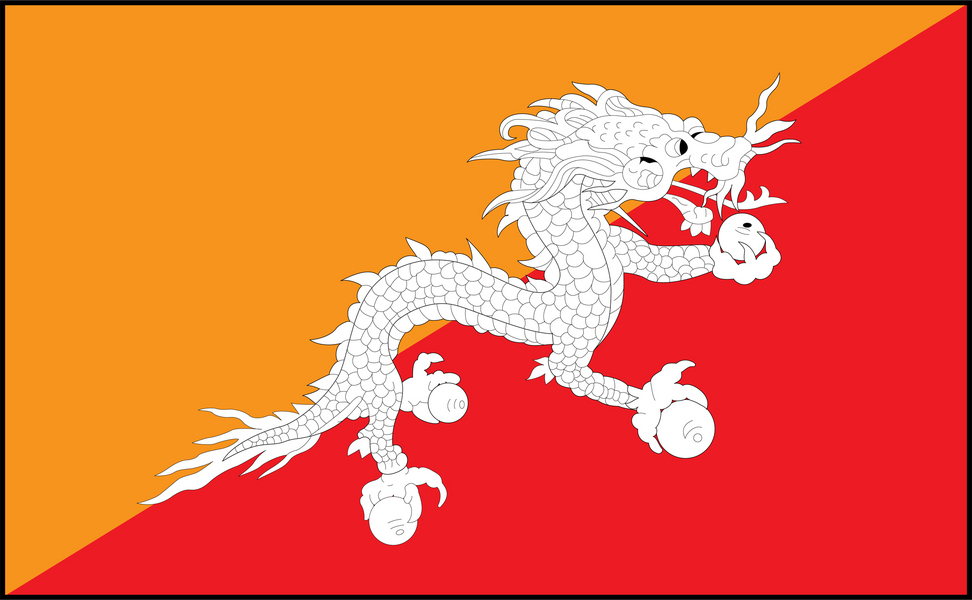
The flag is divided diagonally, yellow in the upper triangle and orange in the lower, with a large white dragon lying along the divide holding jewels in its claws.
Yellow stands for the secular authority of the king and orange for Buddhist spiritual tradition. The dragon is Druk, the thunder dragon: Bhutanese call their country Druk Yul, meaning land of the thunder dragon. The jewels represent the wealth of the nation and the dragon's snarling mouth its strength in defending it.