
Bangladesh
Bangladesh sits on the largest river delta in the world, and it is one of the most densely populated countries on Earth.
- CapitalDhakaOne of the most crowded cities in the world
- PopulationAbout 173 millionOn land smaller than England and Scotland
- Area148,460 km2Almost entirely flat delta
- SundarbansLargest mangrove forestHome to the Bengal tiger
Almost all of Bangladesh is the delta where the Ganges, Brahmaputra and Meghna rivers meet before reaching the Bay of Bengal. It is flat, green and criss-crossed by around 700 rivers, and most of the country is less than 10 m above sea level.
That makes it fertile and dangerous in equal measure. The silt makes the land highly productive, but a fifth of the country can flood in a bad monsoon, and rising sea levels and cyclones from the Bay of Bengal are serious long-term threats.
National symbols
- National animal Royal Bengal tiger
- National flower Water lily
- National anthem Amar Shonar Bangla (Translation: My Golden Bengal)
- National day Independence Day, 26 March
Map of Bangladesh
Geography
Bangladesh covers 148,460 km2 and is almost entirely surrounded by India, with a short border with Myanmar and a coast on the Bay of Bengal.
Nearly the whole country is flat alluvial plain built from river silt. Around 700 rivers cross it. The only significant high ground is the Chittagong Hill Tracts in the south-east, rising to Saka Haphong at about 1,052 m. The Sundarbans mangrove forest covers the south-west coast.
Climate
Bangladesh has a tropical monsoon climate. The rains arrive in June and run to October, delivering around 80 per cent of the annual rainfall in that time.
Summers before the rains are hot and humid, often above 35C, and winters are mild and dry. Tropical cyclones from the Bay of Bengal are a recurring danger, and their storm surges can push far inland across the flat delta.
Culture
Bengali, or Bangla, is the official language and is spoken by nearly everyone. It has one of the richest literary traditions in South Asia, and the poet Rabindranath Tagore wrote the national anthems of both Bangladesh and India.
Around 91 per cent of Bangladeshis are Muslim and around 8 per cent Hindu. Pohela Boishakh, Bengali New Year in April, is celebrated with processions of giant papier-mache animals. Muslin cloth woven here was once famous worldwide for being almost impossibly fine.
Economy
The garment industry dominates. Bangladesh is the second largest exporter of clothing in the world after China, and the sector employs around 4 million people, most of them women.
Agriculture remains important, especially rice, jute and tea. Bangladesh is the world's largest producer of jute, a plant fibre used for sacks and rope, which is why it is nicknamed the golden fibre.
The flag
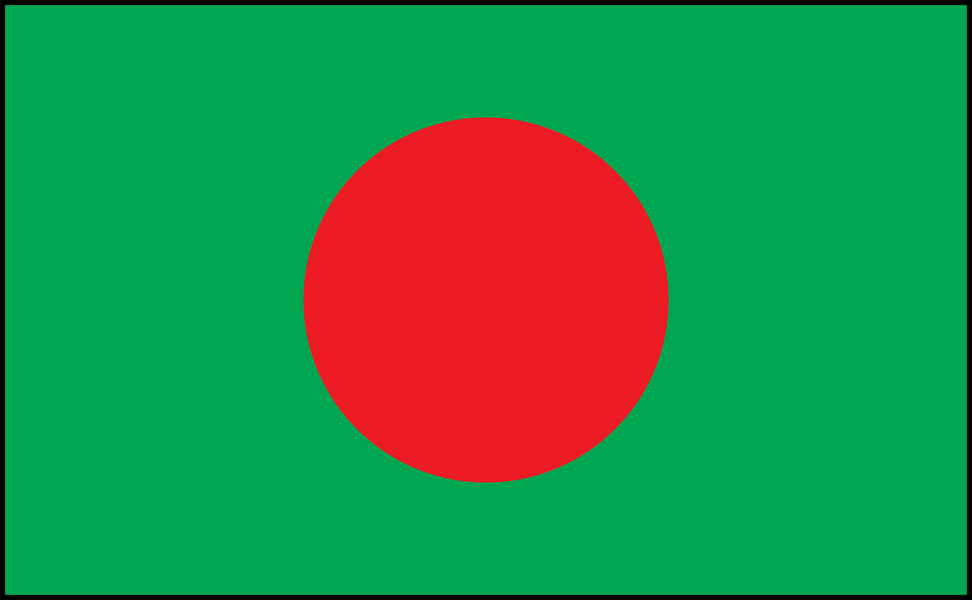
A dark green field with a red disc set slightly towards the flagpole side, so that it appears centred when the flag is flying.
The green stands for the lush landscape of the delta, and the red disc for the sun rising over Bengal and for the blood shed during the war of independence in 1971.