
Bahrain
Bahrain is an archipelago of around 33 islands, and it has a lone tree growing in the middle of the desert with no obvious water source.
- CapitalManamaOn the main island
- PopulationAbout 1.5 millionAround half are foreign nationals
- Area778 km2Around 33 islands
- OilFirst in the GulfDiscovered here in 1932
Bahrain is a small archipelago in the Persian Gulf, joined to Saudi Arabia by a 25 km causeway. The main island holds nearly everyone, and land reclamation has increased the country's area noticeably since the 1960s.
Bahrain was the first Gulf state to find oil, in 1932, and also the first to run low on it, which is why it diversified earlier than its neighbours into banking and services.
National symbols
- National bird Bulbul
- National flower Bahrain rose
- National anthem Bahrainona (Translation: Our Bahrain)
- National day National Day, 16 December
Map of Bahrain
Geography
Bahrain covers 778 km2 and has no land borders, though the King Fahd Causeway links it to Saudi Arabia. It lies in the Persian Gulf between Saudi Arabia and Qatar.
The main island is low and flat, mostly desert, with a central limestone escarpment. The highest point, Jabal ad Dukhan, is only 134 m. Significant areas of the country are reclaimed land, and the number of islands changes as reclamation continues.
Climate
Bahrain has a hot desert climate. Summers are extremely hot and very humid, often above 40C, and the humidity from the surrounding Gulf makes it feel far hotter.
Winters are mild, around 15C to 24C. Rainfall is minimal, under 80 mm a year, mostly in winter. Bahrain historically had natural freshwater springs, which is why it was settled so early, though most have now dried up.
Culture
Arabic is the official language and English is widely spoken. Around half the population is foreign, mainly from South Asia.
Around 70 per cent of Bahrainis are Muslim, and Bahrain has a long-established Christian, Hindu and Jewish presence, unusual in the Gulf. Pearl diving was the historic industry and its heritage sites are UNESCO-listed. Bahrain hosts a Formula 1 Grand Prix.
Economy
Bahrain diversified early because its oil ran short. Banking and financial services are now the largest sector, and Bahrain is a regional financial hub.
Aluminium smelting is significant: Alba is one of the largest aluminium smelters in the world. Refining oil piped from Saudi Arabia, and tourism from Gulf neighbours across the causeway, are also important.
The flag
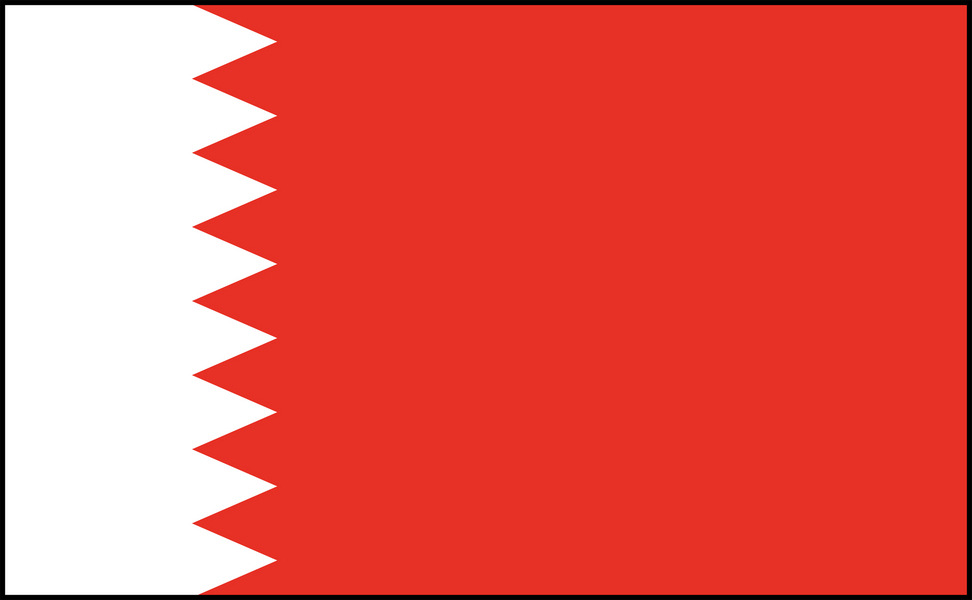
A white vertical band at the flagpole edge and a red field, separated by a zigzag line with five points.
The five points stand for the five pillars of Islam. Red has been the traditional colour of the Gulf states for centuries, and the white was added under a treaty with Britain in the 1800s to distinguish friendly ships. The zigzag was added in 1932 and reduced to five points in 2002.