
Tunisia
Tunisia is the northernmost country in Africa, and parts of the Star Wars films were shot in its desert villages.
- CapitalTunisBeside the ruins of ancient Carthage
- PopulationAbout 12.5 millionThe northernmost African country
- Area163,610 km2Coast, mountains and Sahara
- CarthageFounded around 814 BCRome's greatest rival
Tunisia is the smallest country in North Africa, with a fertile Mediterranean coast in the north, the Atlas Mountains crossing the middle, and the Sahara filling the south.
Carthage, on the coast near modern Tunis, was founded by Phoenicians and became the greatest naval power in the western Mediterranean. Its general Hannibal famously marched an army with elephants over the Alps to attack Rome. Rome eventually destroyed the city in 146 BC.
National symbols
- National bird Common chaffinch
- National flower Jasmine
- National anthem Humat al-Hima (Translation: Defenders of the Homeland)
- National day Independence Day, 20 March
Map of Tunisia
Geography
Tunisia covers 163,610 km2 and borders Algeria and Libya, with the Mediterranean Sea to the north and east.
The Atlas Mountains reach into the north-west, rising to Jebel ech Chambi at 1,544 m. The centre has dry steppe and large salt lakes called chotts, and the south is Sahara. Cap Angela near Bizerte is the northernmost point of the entire African continent.
Climate
The north has a Mediterranean climate with mild wet winters and hot dry summers, which is why olives and citrus grow well there.
The centre is semi-arid steppe and the south is desert, with summer temperatures above 45C and almost no rain. The sirocco, a hot desert wind, can push temperatures up sharply on the coast.
Culture
Arabic is the official language, and French is widely used in business and education. Amazigh is spoken by a small minority in the south.
Almost all Tunisians are Muslim. The medina of Tunis, with thousands of monuments from the 7th century onwards, is a UNESCO World Heritage Site. Tunisia is known for its mosaics: the Bardo Museum holds one of the largest Roman mosaic collections in the world.
Economy
Tunisia has a diversified economy for the region: textiles and clothing, car parts, electrical goods, phosphates and agriculture.
It is one of the world's largest exporters of olive oil, and dates from the southern oases are a significant crop. Tourism to the Mediterranean beaches and historic sites is important, though it has been affected by periods of instability.
The flag
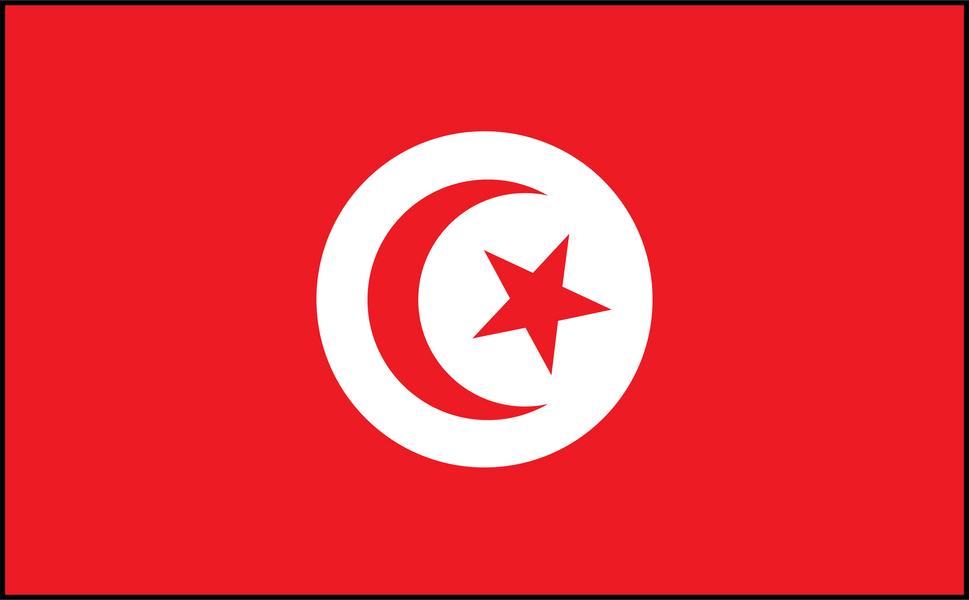
A red field with a white circle in the centre containing a red crescent moon almost encircling a red five-pointed star.
The crescent and star are traditional symbols of Islam. The design dates from around 1831, when Tunisia was under Ottoman rule, and the red is said to recall Ottoman heritage while the white circle stands for the sun.