
Eswatini
Eswatini changed its name from Swaziland in 2018 because people kept confusing it with Switzerland.
- CapitalMbabaneThough the royal capital is Lobamba
- PopulationAbout 1.2 millionOne of Africa's smallest countries
- Area17,364 km2Landlocked between South Africa and Mozambique
- Renamed2018From Swaziland to Eswatini
Eswatini is a small landlocked kingdom squeezed between South Africa and Mozambique. Despite its size it has four distinct regions running north to south, from cool mountainous highveld in the west down to hot lowveld in the east.
In 2018 King Mswati III announced that the country would use its Swazi-language name, Eswatini, meaning land of the Swazis. He noted that Swaziland was regularly confused with Switzerland abroad.
National symbols
- National animal Lion, representing the king, and the elephant for the queen mother
- National flower Fire lily
- National anthem Nkulunkulu Mnikati wetibusiso temaSwati
- National day Independence Day, 6 September
Map of Eswatini
Geography
Eswatini covers 17,364 km2 and borders South Africa on three sides and Mozambique to the east. It is landlocked.
The country divides into four strips: the mountainous highveld in the west, reaching Emlembe at 1,862 m, the middleveld, the hot lowveld, and the Lubombo escarpment along the Mozambican border.
Climate
The highveld has a temperate climate with cool, wet summers and dry winters, while the lowveld is subtropical and much hotter.
Rain falls mostly between October and March. The lowveld can exceed 40C in summer and is prone to drought, while the western mountains can be cold and misty even in the warmer months.
Culture
SiSwati and English are both official languages. Eswatini is unusually homogeneous, with almost all citizens being Swazi.
Around 90 per cent of the population is Christian, often blended with traditional beliefs. The Incwala, or kingship ceremony, held in December or January, is the most sacred national event, and the Umhlanga Reed Dance is the largest.
Economy
Sugar is the largest export, grown on irrigated lowveld estates, along with soft drink concentrate, textiles and timber.
The economy is closely tied to South Africa, which surrounds it on three sides and takes most of its exports. Eswatini's currency is pegged to the South African rand and both circulate.
The flag
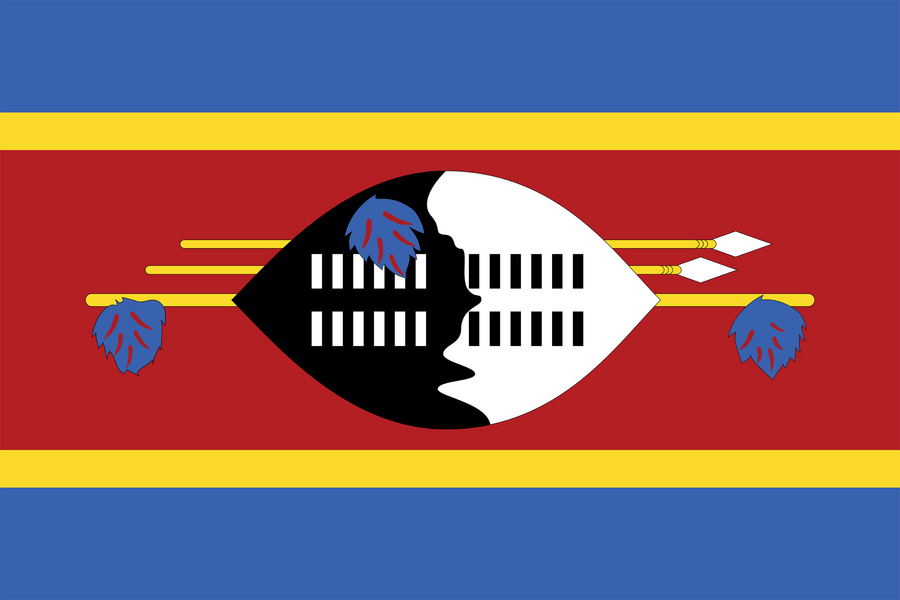
Three horizontal bands, blue at the top and bottom with a wider red band in the middle edged in yellow, and a black and white Nguni shield laid horizontally across the centre with two spears and a fighting staff.
Blue stands for peace, yellow for the country's mineral resources and red for past battles. The shield is decorated with tassels of injobo feathers, and its black and white colours are said to show that black and white people live together peacefully.