
Sudan
Sudan has more pyramids than Egypt, around 200 of them, built by the kingdom of Kush.
- CapitalKhartoumWhere the Blue and White Nile meet
- PopulationAbout 48 millionIn north-east Africa
- Area1,861,484 km2Third largest country in Africa
- PyramidsAround 200More than Egypt has
Sudan sits where the Sahara meets the Sahel. Khartoum is built at the confluence where the Blue Nile, flowing from the Ethiopian highlands, meets the White Nile from Uganda, and the two join to form the Nile proper.
The kingdom of Kush ruled this land for centuries and at one point conquered Egypt, ruling it as the 25th Dynasty. Its rulers built steep-sided pyramids at Meroe and Nuri, and around 200 survive, more than in Egypt, though they are smaller and less visited.
National symbols
- National bird Secretary bird
- National flower Hibiscus
- National anthem Nahnu Djundulla Djundulwatan (Translation: We Are the Soldiers of God)
- National day Independence Day, 1 January
Map of Sudan
Geography
Sudan covers 1,861,484 km2 and borders Egypt, Eritrea, Ethiopia, South Sudan, the Central African Republic, Chad and Libya, with a Red Sea coast in the north-east.
The Nile runs the length of the country. The north is Sahara, the centre is semi-arid Sahel and the south is savannah. The Red Sea Hills rise in the east, and the Marrah Mountains in Darfur reach around 3,042 m.
Climate
Sudan is hot and dry over most of its area. The north is true desert with almost no rain, and summer temperatures regularly exceed 45C.
Rainfall increases towards the south, where a summer wet season supports savannah farming. The haboob, a wall of dust hundreds of metres high driven by thunderstorm winds, can engulf Khartoum in minutes.
Culture
Arabic and English are both official, and around 70 languages are spoken including Nubian and Beja.
Almost all Sudanese are Muslim. The country has a strong tradition of poetry and of Sufi practice: the whirling dervishes at Omdurman perform a spinning devotional ceremony every Friday. Civil war since 2023 has displaced millions of people.
Economy
Sudan lost most of its oil when South Sudan separated in 2011. Gold has since become the leading export, much of it from artisanal mining.
Agriculture employs most of the population, growing sorghum, sesame, cotton and groundnuts. Sudan is the world's largest producer of gum arabic, a tree sap used in soft drinks, sweets and printing.
The flag
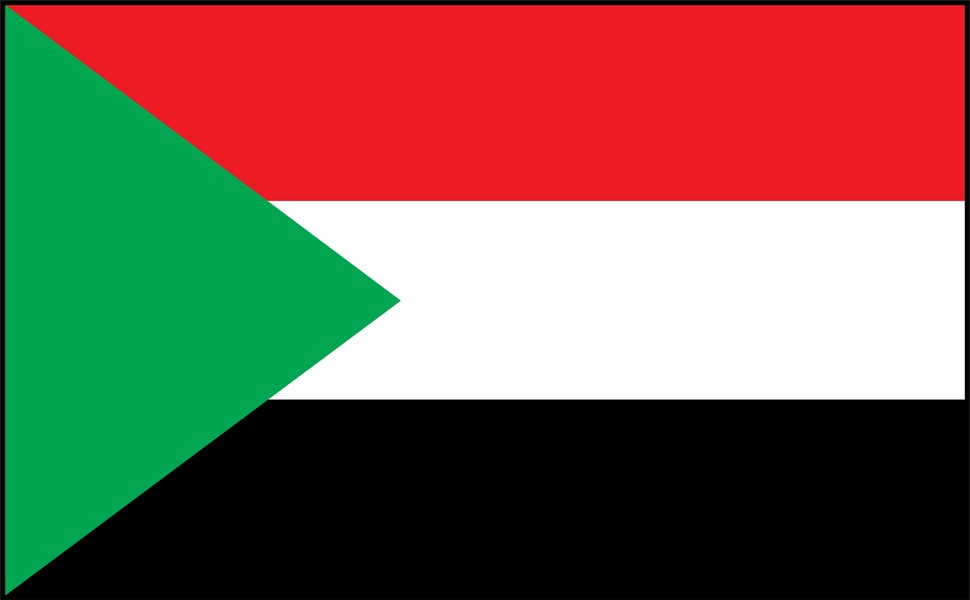
Three horizontal bands of red, white and black with a green triangle at the flagpole edge. These are the pan-Arab colours.
Red stands for the struggle and the blood of martyrs, white for peace and optimism, black for Sudan itself, whose name comes from an Arabic phrase meaning land of the blacks, and green for Islam, agriculture and prosperity.