
South Sudan
South Sudan is the world's youngest country, becoming independent in 2011, and it contains one of the largest wetlands on Earth.
- CapitalJubaOn the White Nile
- PopulationAbout 11 millionLandlocked in north-east Africa
- Area644,329 km2Savannah, swamp and grassland
- Independence2011The world's newest country
South Sudan became independent from Sudan in 2011 after a referendum, following decades of civil war. It is the newest internationally recognised country in the world.
The Sudd, in the centre of the country, is one of the largest wetlands on Earth. The White Nile spreads out across it into a maze of channels, papyrus swamp and floating vegetation, so vast that it slows the river and evaporates around half its water.
National symbols
- National animal African fish eagle
- National colours Black, red, green, blue and gold
- National anthem South Sudan Oyee!
- National day Independence Day, 9 July
Map of South Sudan
Geography
South Sudan covers 644,329 km2 and borders Sudan, Ethiopia, Kenya, Uganda, the Democratic Republic of Congo and the Central African Republic. It is landlocked.
The White Nile runs the length of the country and spreads into the Sudd wetland in the centre. Savannah and grassland cover most of the rest, with highlands on the Ugandan and Ethiopian borders where Mount Kinyeti reaches 3,187 m.
Climate
South Sudan is tropical with a long rainy season from April to October and a hot dry season for the rest of the year.
Temperatures are high throughout, often above 35C in the dry season. The rains cause extensive flooding across the flat central plains, and in recent years flooding has been unusually severe and prolonged.
Culture
English is the official language, and over 60 indigenous languages are spoken, including Dinka, Nuer and Bari. Juba Arabic is widely used as a link language.
Around 60 per cent of South Sudanese are Christian, with traditional beliefs also widely followed. Cattle are central to social life among many groups, used for bride price, wealth and identity, and cattle camps are a way of life.
Economy
Oil provides almost all government revenue and export earnings. Because the country is landlocked, that oil must be piped north through Sudan to reach the sea, which has caused repeated disputes.
Most people are subsistence farmers or cattle herders. Civil conflict since 2013 has severely disrupted the economy and displaced millions, and South Sudan is one of the poorest countries in the world.
The flag
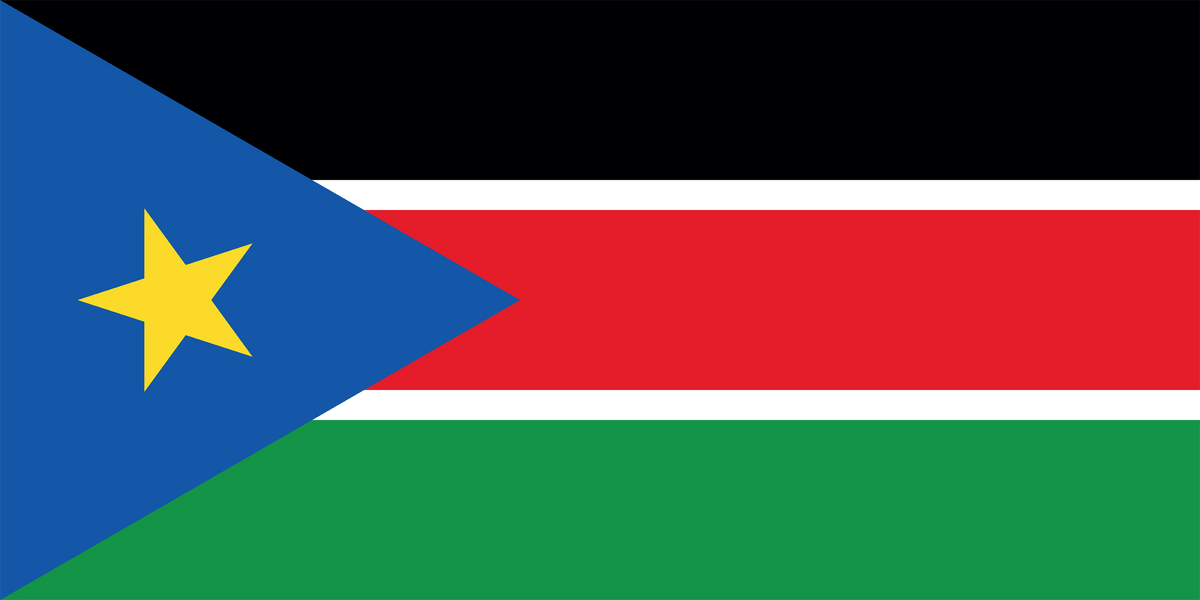
Three horizontal bands of black, red and green separated by thin white stripes, with a blue triangle at the flagpole edge bearing a gold five-pointed star.
Black stands for the people, red for the blood shed for freedom, green for the land, white for peace, and blue for the waters of the Nile. The gold star, called the Star of Bethlehem, stands for the unity of the states of South Sudan.