
South Africa
South Africa has three capital cities and twelve official languages, more than almost any country in the world.
- CapitalsThreePretoria, Cape Town and Bloemfontein
- PopulationAbout 61 millionAt the southern tip of Africa
- Area1,221,037 km2From desert to subtropical coast
- Official languages12Including South African Sign Language
South Africa splits its government across three cities: Pretoria holds the executive, Cape Town the parliament and Bloemfontein the supreme court of appeal. The arrangement was a compromise when the country was formed in 1910.
Apartheid, a system of enforced racial separation, ran from 1948 until 1994. Nelson Mandela spent 27 years in prison under it, then became the country's first democratically elected president, and South Africa is now often called the Rainbow Nation.
National symbols
- National animal Springbok
- National flower King protea
- National anthem National Anthem of South Africa, sung in five languages
- National day Freedom Day, 27 April
Map of South Africa
Geography
South Africa covers 1,221,037 km2 and borders Namibia, Botswana, Zimbabwe, Mozambique and Eswatini, and completely surrounds Lesotho. The Atlantic and Indian Oceans meet at its southern tip.
A high interior plateau called the Highveld is separated from the coast by the Great Escarpment, whose highest part is the Drakensberg, reaching 3,450 m. The Kalahari semi-desert lies in the north-west and the Karoo in the centre.
Climate
South Africa is mostly semi-arid, but the climate varies widely. Cape Town has a Mediterranean climate with wet winters and dry summers, while the east coast around Durban is subtropical and humid.
The interior plateau has hot summers with dramatic afternoon thunderstorms and cold, dry winters, with frost and occasional snow on the Drakensberg. Water shortages are a recurring national concern.
Culture
South Africa recognises twelve official languages: Zulu, Xhosa, Afrikaans, English, Sepedi, Setswana, Sesotho, Xitsonga, siSwati, Tshivenda, isiNdebele and South African Sign Language. Zulu has the most speakers.
Around 85 per cent of South Africans are Christian, with traditional African beliefs often practised alongside. The braai, an outdoor barbecue, is a national institution, and rugby, cricket and football all have huge followings.
Economy
South Africa has one of Africa's most developed economies, built originally on mining: gold, platinum, diamonds, chromium and coal. It produces the majority of the world's platinum.
Manufacturing, finance and agriculture, especially wine, citrus and maize, are also major. Tourism draws visitors for safaris in Kruger National Park, the Garden Route and Cape Town.
The flag
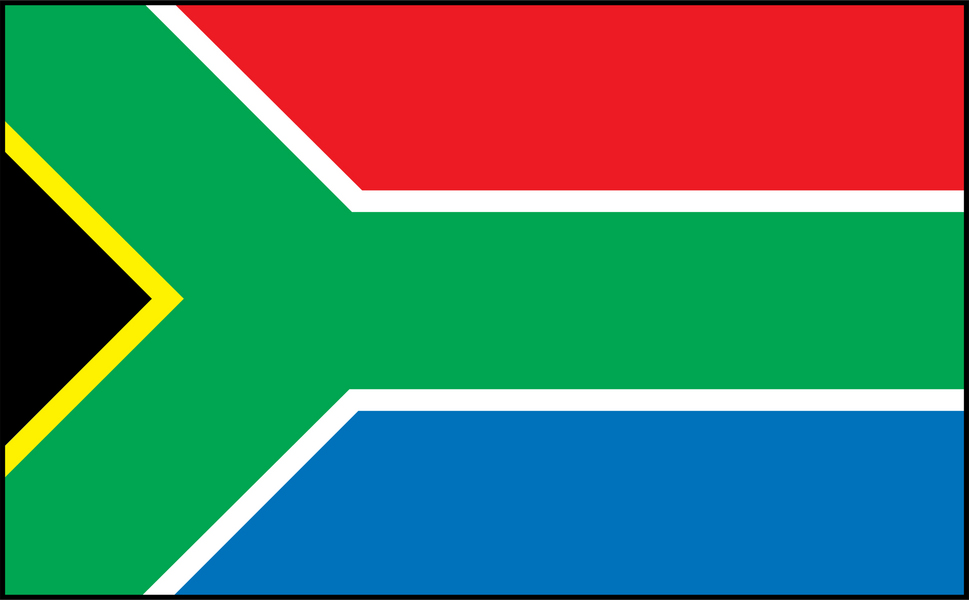
A horizontal green Y shape, edged in white and gold, running from the flagpole into the centre, separating a red band above from a blue band below, with a black triangle at the flagpole edge.
Adopted in 1994 for the first democratic election, it deliberately uses colours from both the old flags and the African National Congress. The Y shape stands for the convergence of different paths into one road forward, and the design is the only national flag with six colours and no seal or emblem.