
Sierra Leone
Sierra Leone has one of the largest natural harbours in the world, and its name means lion mountains in Portuguese.
- CapitalFreetownFounded as a home for freed slaves
- PopulationAbout 8.6 millionOn the West African coast
- Area71,740 km2Coast, forest and highlands
- HarbourOne of the world's largest natural harboursAt Freetown
Sierra Leone was named by a Portuguese explorer in 1462 who thought the mountains behind the coast looked like a crouching lion, or heard thunder rolling around them like a lion's roar. Serra Leoa became Sierra Leone.
Freetown was founded in 1792 as a settlement for freed enslaved people from Britain, Nova Scotia and Jamaica, and later for Africans rescued from slave ships. Their descendants, the Krio, gave the country its widely spoken Krio language.
National symbols
- National animal Lion
- National colours Green, white and blue
- National anthem High We Exalt Thee, Realm of the Free
- National day Independence Day, 27 April
Map of Sierra Leone
Geography
Sierra Leone covers 71,740 km2 and borders Guinea and Liberia, with the Atlantic Ocean to the west.
A swampy coastal belt gives way to plains and then to plateaus and mountains in the east, where Mount Bintumani reaches 1,945 m. The Freetown Peninsula has forested hills rising straight from the sea and shelters one of the largest natural harbours in the world.
Climate
Sierra Leone is tropical with a long rainy season from May to November and a dry season from December to April.
Rainfall is very heavy, and Freetown receives over 3,000 mm a year, among the highest on the West African coast. The harmattan brings dry dusty air in December and January.
Culture
English is the official language, and Krio, an English-based creole, is spoken by most of the population as a common language. Mende and Temne are the largest indigenous languages.
Around 78 per cent of Sierra Leoneans are Muslim and around 21 per cent Christian, and the country is often noted for the ease with which the two communities live together, including in mixed families.
Economy
Mining is central: diamonds, rutile, bauxite and iron ore. Sierra Leone is one of the world's largest producers of rutile, a titanium ore used in paint and aerospace.
Agriculture employs most people, growing rice, cassava and cocoa. The country is still rebuilding from a civil war that ended in 2002 and from the Ebola epidemic of 2014 to 2016.
The flag
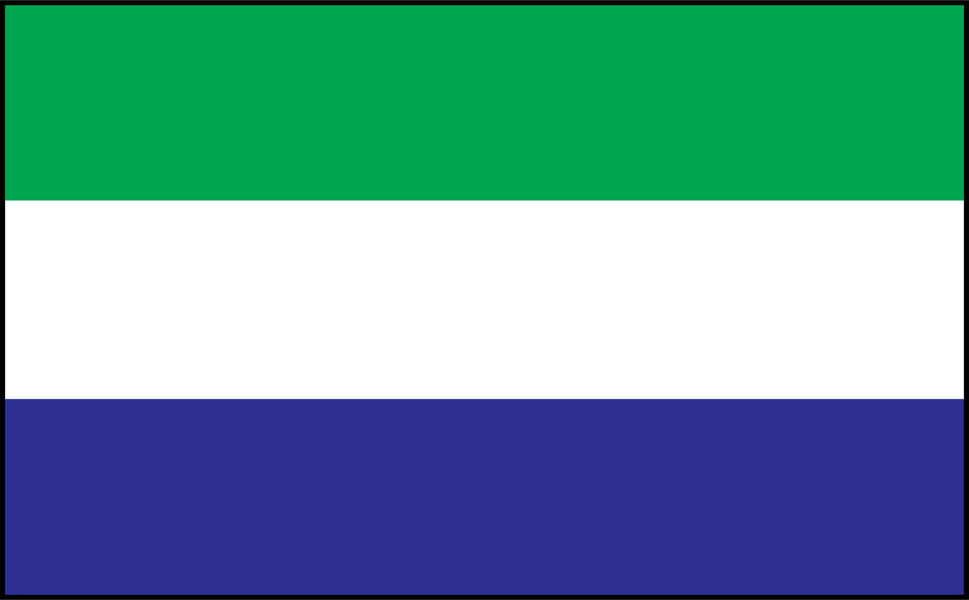
Three horizontal bands of green, white and blue. Green stands for agriculture and the country's natural resources and mountains.
White stands for unity and justice, and blue for the hope that the great natural harbour at Freetown will contribute to peace and prosperity. It is one of very few African flags to include blue for a harbour rather than for the sea generally.