
Seychelles
Seychelles has the largest seed in the world, the coco de mer, which can weigh up to 25 kg and grows only on two islands.
- CapitalVictoriaOne of the smallest capitals in the world
- PopulationAbout 100,000The smallest population in Africa
- Area459 km2115 islands in the Indian Ocean
- Coco de merUp to 25 kgThe largest seed of any plant
Seychelles is an archipelago of 115 islands scattered across the western Indian Ocean. Unusually, the inner islands are granite, fragments of an ancient continent, which makes them geologically different from almost every other tropical island group. The outer islands are low coral atolls.
The coco de mer palm grows naturally only in the Vallee de Mai on Praslin and on Curieuse. Its seed is the largest of any plant in the world, weighing up to 25 kg, and takes six to seven years to ripen.
National symbols
- National bird Seychelles black parrot
- National tree Coco de mer
- National anthem Koste Seselwa (Translation: Join Together All Seychellois)
- National day Constitution Day, 18 June
Map of Seychelles
Geography
Seychelles covers 459 km2 of land spread across 1.3 million km2 of the Indian Ocean, with no land borders. Mahe holds most of the population.
The inner islands are granite, the exposed peaks of an ancient submerged continental fragment, with beaches famous for their huge rounded boulders. Morne Seychellois on Mahe reaches 905 m. The outer islands, including Aldabra, are low coral atolls.
Climate
Seychelles is tropical, warm and humid all year at around 24C to 32C, with little seasonal variation because it lies close to the equator.
The north-west monsoon from November to March brings the heaviest rain, and the south-east trade winds from May to September are drier and breezier. Seychelles lies outside the main cyclone belt.
Culture
Seychellois Creole, English and French are all official. Creole, based on French, is what most people speak at home.
Around 76 per cent of Seychellois are Roman Catholic. The population descends from French settlers, enslaved Africans, Indian and Chinese traders, producing a distinctive Creole culture. Sega and moutya, both African-rooted dance forms, are the traditional music.
Economy
Tourism is the largest industry, focused on high-value visitors rather than mass tourism, and Seychelles has the highest income per person in Africa.
Tuna fishing and canning is the second pillar, with Port Victoria a major Indian Ocean tuna hub. Seychelles has pioneered blue bonds, borrowing money on condition it is spent protecting the ocean.
The flag
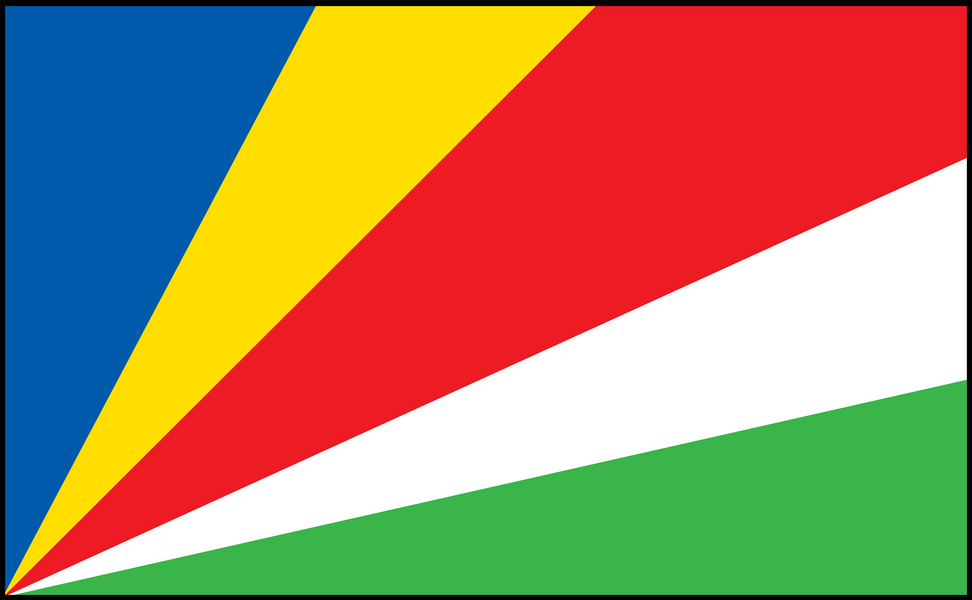
Five bands of blue, yellow, red, white and green radiating out from the bottom left corner like rays, an unusual design for a national flag.
Blue stands for the sky and the sea, yellow for the sun, red for the people and their determination, white for social justice and harmony, and green for the land and the natural environment. The radiating design suggests a dynamic young country moving into the future.