
Senegal
Senegal is the westernmost country in mainland Africa, and it almost completely surrounds another country, The Gambia.
- CapitalDakarOn the westernmost point of mainland Africa
- PopulationAbout 18 millionIn West Africa
- Area196,722 km2Mostly low, flat savannah
- SurroundsThe GambiaExcept for its short coastline
Senegal occupies the far western tip of Africa, with Dakar sitting on a peninsula that is the continent's westernmost point. The land is mostly flat and low, savannah in the north and wetter woodland in the south.
The Gambia is a long thin country following the Gambia River, and Senegal wraps around it on three sides, so travelling between northern and southern Senegal usually means crossing Gambian territory or going a long way round.
National symbols
- National animal Lion
- National tree Baobab
- National anthem Pincez tous vos koras, frappez les balafons
- National day Independence Day, 4 April
Map of Senegal
Geography
Senegal covers 196,722 km2 and borders Mauritania, Mali, Guinea, Guinea-Bissau and The Gambia, which it almost completely encloses. The Atlantic Ocean lies to the west.
The country is mostly low and flat, with the highest point only around 648 m in the south-east. The Senegal River forms the northern border, and the Casamance region in the south, cut off by The Gambia, is greener and more forested than the rest.
Climate
Senegal has a tropical climate with a dry season from November to May and a rainy season from June to October, driven by the West African monsoon.
The north is semi-arid Sahel, hot and dry, while the southern Casamance gets considerably more rain. The coast is cooled by ocean breezes and the harmattan wind brings Saharan dust in winter.
Culture
French is the official language, and Wolof is the language most people actually use across ethnic groups. Around 20 languages are spoken.
Around 97 per cent of Senegalese are Muslim, mostly following Sufi brotherhoods that are central to social life. Mbalax, a percussion-driven dance music, is the national style, and Youssou N'Dour is its best-known artist internationally. Teranga, meaning hospitality, is a defining national value.
Economy
Fishing is central to the economy and to daily diet, though foreign industrial fleets have put pressure on stocks. Groundnuts, cotton and horticulture are the main crops.
Phosphates are mined and processed, and Senegal has begun producing oil and gas offshore. Dakar is a regional business hub with a deep-water port, and tourism draws visitors to the coast and to Goree Island.
The flag
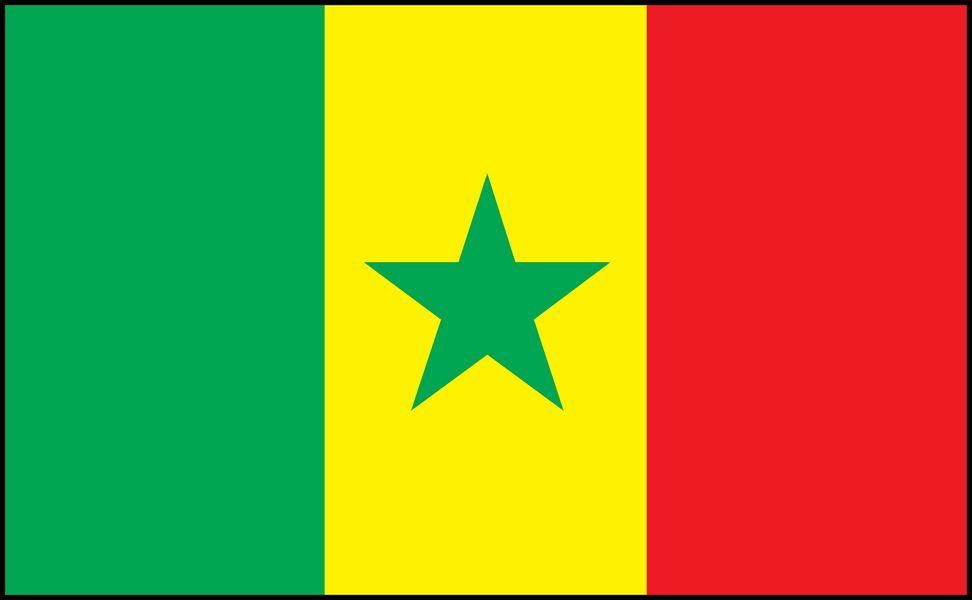
Three vertical bands of green, yellow and red with a green five-pointed star in the centre of the yellow band.
These are the pan-African colours. Green stands for Islam and for hope, yellow for wealth and the fruits of labour, and red for the blood shed for independence and for the will to fight poverty. The green star stands for unity and hope.