
Sao Tome and Principe
Sao Tome and Principe is the second smallest country in Africa, and it sits almost exactly on the equator.
- CapitalSao TomeOn the larger island
- PopulationAbout 230,000Second smallest in Africa
- Area964 km2Two main volcanic islands
- CocoaOnce the world's largest producerFrom plantations called rocas
Sao Tome and Principe is a two-island nation in the Gulf of Guinea, sitting on the equator about 250 km off the coast of Gabon. Both islands are volcanic, steep and covered in rainforest, with dramatic rock spires left where old volcanic plugs resisted erosion.
Uninhabited before the Portuguese arrived in the 1470s, the islands became the world's largest cocoa producer in the early 1900s, worked by forced labour on plantations called rocas. Many of those plantation buildings still stand, slowly being reclaimed by the forest.
National symbols
- National bird Sao Tome ibis
- National colours Green, yellow, red and black
- National anthem Independencia total (Translation: Total Independence)
- National day Independence Day, 12 July
Map of Sao Tome and Principe
Geography
Sao Tome and Principe covers 964 km2 and has no land borders, lying in the Gulf of Guinea about 250 km off Gabon. The equator passes just south of Sao Tome island.
Both islands are the tops of extinct volcanoes rising from the sea floor. Pico de Sao Tome is the highest point at 2,024 m. Steep rainforest covers much of both islands, and dramatic volcanic plugs rise out of the canopy.
Climate
The islands are equatorial: hot, humid and wet, generally 22C to 30C, with little seasonal variation in temperature.
There is a drier season, the gravana, from June to September. Rainfall is very high in the south-west, over 5,000 mm a year in places, and much lower in the north-east, which creates strikingly different vegetation over short distances.
Culture
Portuguese is the official language, and several Portuguese-based creoles are spoken, including Forro and Angolar.
Around 55 per cent of the population is Roman Catholic. Because the islands were uninhabited before colonisation, the culture is Creole, formed from Portuguese settlers and Africans brought from the mainland. Tchiloli, a centuries-old dance drama performed in masks, is unique to Sao Tome.
Economy
Cocoa remains the main export, now often grown organically and sold to specialist chocolate makers, along with coffee, coconut and palm oil.
Tourism is small but growing, focused on rainforest, birdwatching and beaches. Oil has been explored in the Gulf of Guinea but has not yet been produced in commercial quantities.
The flag
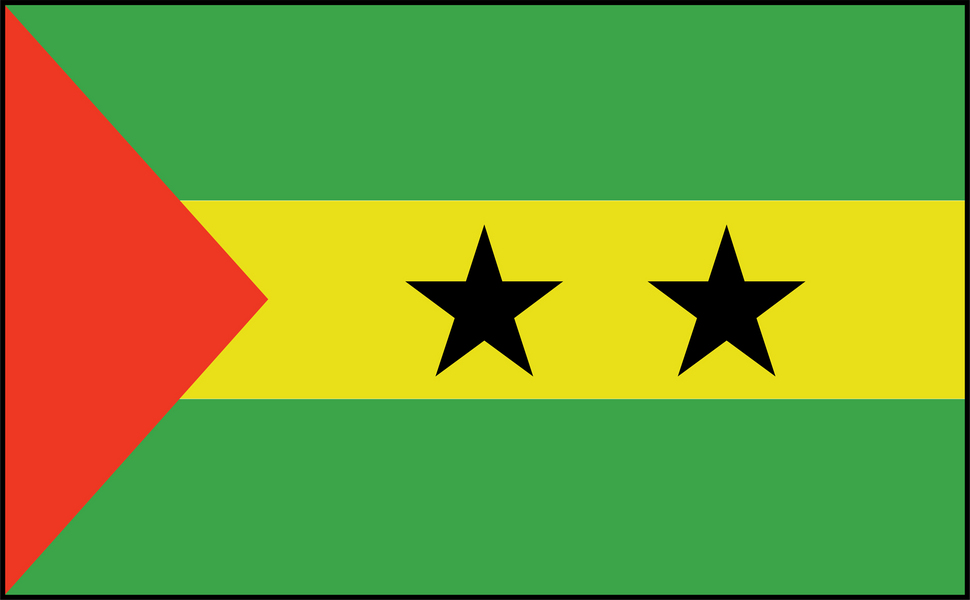
Three horizontal bands of green, yellow and green, with the yellow band the widest and carrying two black five-pointed stars, and a red triangle at the flagpole edge.
Green stands for the islands' vegetation, yellow for cocoa and the sun, and red for the struggle for independence. The two black stars represent the two islands and the African people who live on them.