
Rwanda
Rwanda is called the land of a thousand hills, and it banned single-use plastic bags in 2008, long before most countries considered it.
- CapitalKigaliOften ranked among Africa's cleanest cities
- PopulationAbout 14 millionThe most densely populated mainland African country
- Area26,338 km2Small, hilly and crowded
- Plastic bagsBanned in 2008Among the first countries to do so
Rwanda is small, landlocked and extremely hilly, which is why it is called the land of a thousand hills. It is the most densely populated country on mainland Africa, and its steep hillsides are terraced and farmed almost everywhere.
In 1994 around 800,000 people, mostly Tutsi, were killed in around 100 days during the genocide. Rwanda's recovery since then, including community courts, a national day of remembrance and rapid economic growth, is one of the most studied national reconstructions anywhere.
National symbols
- National animal Mountain gorilla
- National colours Blue, yellow and green
- National anthem Rwanda Nziza (Translation: Beautiful Rwanda)
- National day Independence Day, 1 July
Map of Rwanda
Geography
Rwanda covers 26,338 km2 and borders Uganda, Tanzania, Burundi and the Democratic Republic of Congo. It is landlocked.
The whole country is hilly, sitting mostly above 1,000 m. The Virunga volcanic chain runs along the north-western border and includes Mount Karisimbi at 4,507 m. Lake Kivu, on the Congolese border, is one of the deepest lakes in Africa and holds large quantities of dissolved methane.
Climate
Despite lying just south of the equator, Rwanda has a temperate climate because of its altitude, generally 15C to 27C all year.
There are two rainy seasons, from February to May and September to December. The mountains are cooler and wetter, and the eastern lowlands are warmer and drier.
Culture
Kinyarwanda is the national language, spoken by essentially everyone, with English, French and Swahili also official. Having one shared indigenous language is unusual in Africa.
Around 94 per cent of Rwandans are Christian. Imigongo, a traditional art form using cow dung mixed with ash and clay to make raised geometric patterns, is distinctive to Rwanda. Intore dance, with tall headdresses and spears, is performed at national occasions.
Economy
Agriculture employs most Rwandans, growing coffee, tea, bananas and beans on terraced hillsides. Rwandan speciality coffee has a strong international reputation.
Gorilla trekking permits are among the most expensive wildlife experiences in the world, and tourism is the largest source of foreign earnings. Rwanda has also positioned itself as a technology and conference hub for the region.
The flag
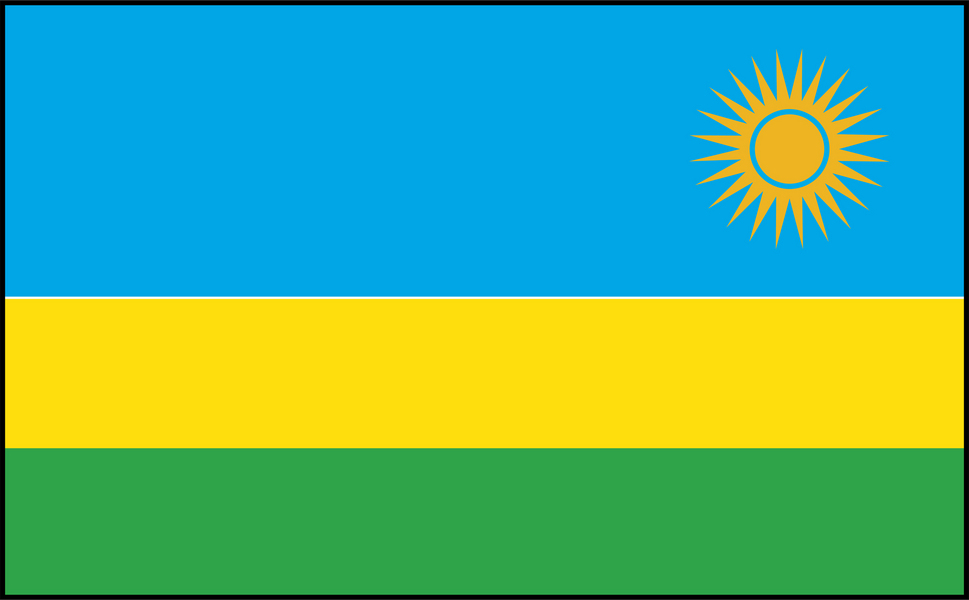
Three horizontal bands: a wide sky blue band on top, then narrower yellow and green bands, with a golden sun with 24 rays in the top right corner.
Blue stands for happiness and peace, yellow for economic development, and green for hope and prosperity. The sun represents enlightenment. The flag was adopted in 2001 to replace the previous one, which had become associated with the genocide.