
Nigeria
Nigeria has more people than any other country in Africa, and its film industry produces more films each year than Hollywood.
- CapitalAbujaPurpose-built and made capital in 1991
- PopulationAbout 224 millionThe most populous country in Africa
- Area923,769 km2From coastal swamp to Sahel
- NollywoodOver 2,000 films a yearMore than Hollywood
Nigeria stretches from mangrove swamps and rainforest on the Gulf of Guinea coast, through savannah in the middle, to the dry Sahel in the far north. The Niger and Benue rivers meet in the centre and flow south to a huge delta.
It is by far the most populous country in Africa, and one of the most linguistically varied places on Earth, with over 500 languages spoken. Three groups are largest: the Hausa in the north, the Yoruba in the south-west and the Igbo in the south-east.
National symbols
- National animal Eagle
- National flower Costus spectabilis, the yellow trumpet
- National anthem Arise, O Compatriots
- National day Independence Day, 1 October
Map of Nigeria
Geography
Nigeria covers 923,769 km2 and borders Benin, Niger, Chad and Cameroon, with the Gulf of Guinea to the south.
The Niger Delta in the south is one of the largest river deltas in the world and holds the country's oil. Behind it lie rainforest and then savannah plateau. The Jos Plateau rises in the centre, and Chappal Waddi at around 2,419 m near the Cameroon border is the highest point.
Climate
Nigeria is tropical, and the amount of rain falls sharply as you travel north. The south is hot and wet with two rainy seasons and over 2,000 mm of rain a year.
The middle belt has one long rainy season, and the far north is semi-arid Sahel with a short wet season and a long dry one. The harmattan, a dry dusty wind off the Sahara, blows south between December and February.
Culture
English is the official language, chosen because no single Nigerian language is spoken by everyone. Hausa, Yoruba and Igbo are the largest of over 500 indigenous languages.
Around 54 per cent of Nigerians are Muslim, mostly in the north, and around 46 per cent Christian, mostly in the south. Nigerian writers including Chinua Achebe and Wole Soyinka, Africa's first Nobel literature laureate, are read worldwide.
Economy
Nigeria has one of the largest economies in Africa. Oil from the Niger Delta provides most export earnings, though it employs relatively few people.
Agriculture supports most of the workforce, growing cassava, yams, maize and sorghum. Nigeria is the world's largest producer of both cassava and yams. Banking, telecoms and entertainment have grown rapidly in Lagos.
The flag
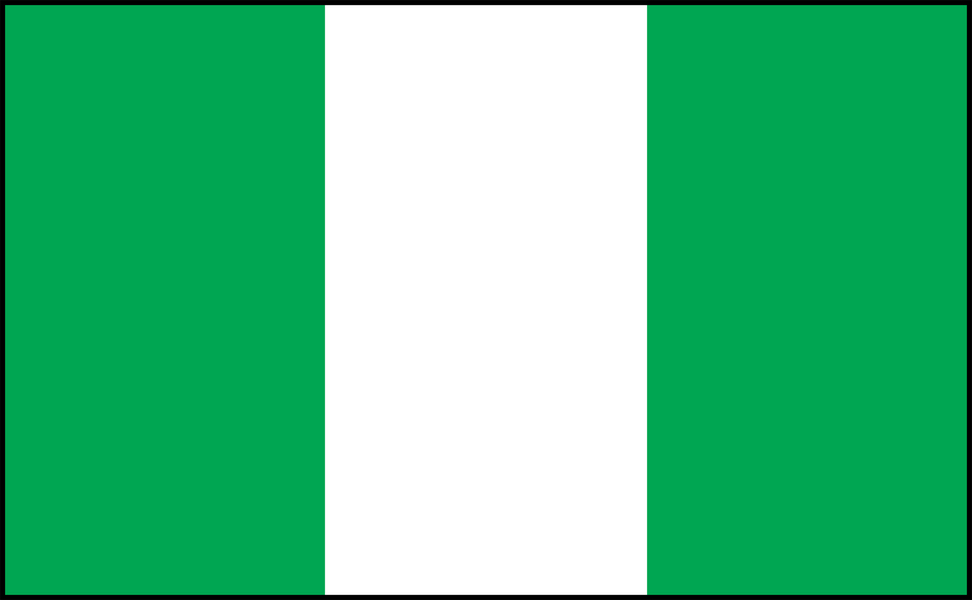
Three equal vertical bands: green, white, green. It is one of the simplest national flags anywhere.
The green stands for Nigeria's forests and abundant natural wealth, and the white for peace and unity. It was designed in 1959 by Michael Taiwo Akinkunmi, a 23-year-old student, who won a national competition with an entry that originally had a red sun in the middle.