
Mauritius
Mauritius was the only home of the dodo, a flightless bird that was extinct within about a century of humans arriving.
- CapitalPort LouisOn the north-west coast
- PopulationAbout 1.3 millionIn the Indian Ocean
- Area2,040 km2A volcanic island plus smaller ones
- DodoExtinct by around 1681Found nowhere else on Earth
Mauritius is a volcanic island about 2,000 km off the south-east coast of Africa, ringed by one of the world's largest continuous coral reefs. Its interior is a plateau of old lava flows with sharp jagged peaks left where softer rock eroded away.
The dodo lived only here. A large flightless pigeon with no natural predators, it had no fear of humans and was wiped out within about a century of Dutch sailors arriving in 1598, mainly by the rats, pigs and monkeys they brought with them.
National symbols
- National bird Dodo, extinct but still the national emblem
- National flower Trochetia boutoniana, the boucle d'oreille
- National anthem Motherland
- National day Independence Day, 12 March
Map of Mauritius
Geography
Mauritius covers 2,040 km2 and has no land borders, lying about 2,000 km east of mainland Africa and around 900 km east of Madagascar. Rodrigues and several smaller islands are also part of the country.
The main island is volcanic, with a central plateau ringed by sharp mountain peaks including Piton de la Petite Riviere Noire at 828 m. An almost unbroken coral reef surrounds the island, creating calm turquoise lagoons.
Climate
Mauritius has a tropical maritime climate with a warm wet summer from November to April and a cooler dry winter from June to September.
The central plateau is noticeably cooler and much wetter than the coast, receiving several times as much rain. Cyclones can strike between January and March.
Culture
English is the official language of parliament, French is widely used in media, and Mauritian Creole is what nearly everyone speaks at home. Bhojpuri is also spoken.
The population is exceptionally mixed: around 48 per cent Hindu, 26 per cent Christian and 17 per cent Muslim, descended from Indian indentured labourers, enslaved Africans, French and British settlers and Chinese traders. Sega, a dance and music form created by enslaved people, is on the UNESCO heritage list.
Economy
Mauritius has one of Africa's highest incomes per person. It moved from a sugar economy to textiles, then to tourism, finance and information technology.
It is a major offshore financial centre, particularly for investment into India and Africa. Sugar cane still covers a large share of the farmland, and luxury beach tourism is a major earner.
The flag
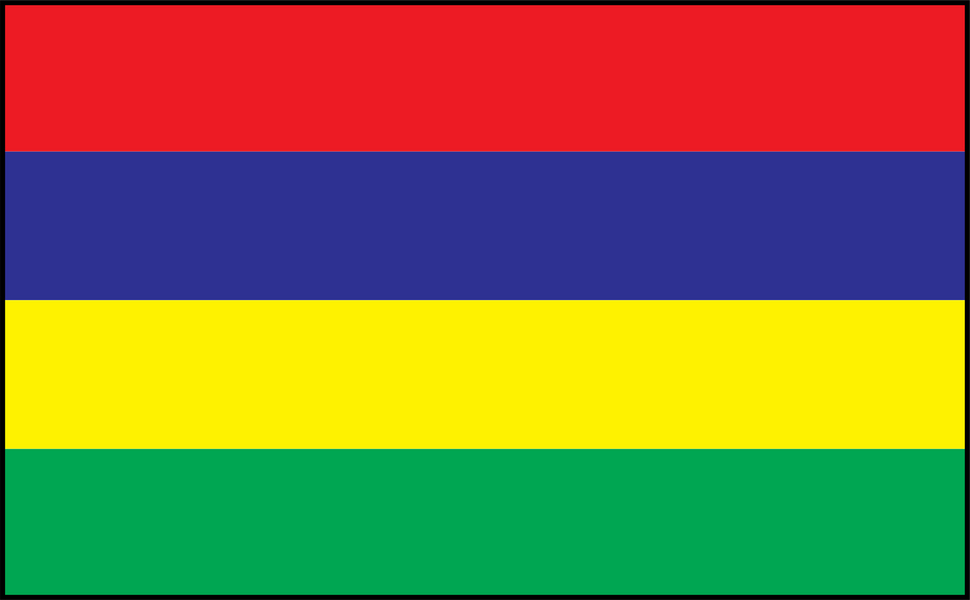
Four horizontal bands of red, blue, yellow and green, unusual because most national flags use three bands or fewer.
Red stands for the struggle for independence, blue for the Indian Ocean surrounding the island, yellow for the light of independence shining over the country, and green for the year-round vegetation of the island.